The Law of Graphic Equalisation
Statement
Matthew Parslow
Independent Researcher
Draft — draft-2026-09-06.1
6 September 2026 ∙ statement
STATEMENT. This is the theory; the companion Law of Graphic Equalisation (Theory) is the case for it. What is missing here is not detail but argument — the removals that establish how little is required are the long paper’s bulk and its actual work, so anything below that a reader wants shown rather than asserted is shown there. Calling this a short form would describe it by its length instead of by what it does. Every axiom, definition, theorem and proposition below is pulled from the long paper at build time, and so are the falsifiability commitments attached to them, so none of those can drift from it; the commitments the long paper carries for material not stated here are listed by title at the end, so the omission stays checkable in this document rather than only in the build log. The connecting prose is written here and is not synchronised, so it can. Four companions are named in the material below without being carried by it: Is (the base claim this paper begins after), the physics companion, the mind companion, and Narrativium.
Abstract
One minimal structure is proposed as underlying phenomena usually studied apart. This statement gives the structure, the frame machinery through which anything reaches it, what happens when a write is refused, the single prohibition it carries, and the commitments on which it fails. It argues for none of them. The removals that establish how little is required are the long paper’s bulk, and a reader who doubts a particular claim here should expect to be persuaded there and not by this.
1 The substrate#
The substrate is structure, the transformations operative upon it, and a grammar of which relations
may exist. Only the first is required for there to be anything; the other two are what a world in which
anything happens costs. Nothing beyond the three is primitive, and anything else exists where a graph
happens to represent it.
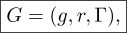
Definition 1.1 (Graph). A graph is
where g is represented state, r is operative transformation structure, and Γ is the admissibility grammar governing graph-originated transformations.
Nothing in that is typed, and the omission is the definition’s content rather than its brevity.
What the word graph denotes here is the floor — difference, and what differing consists in —
while the typed object the word ordinarily calls to mind is derived and arrives with anything that runs (Remark 3.11 of the long paper (What plurality forces, and what it does not)). A reader supplies the typing regardless, which is why this is said here and again where it matters rather than left to the definition to carry alone.
Definition 1.2 (Grounding). A grounding is a particular assignment of rule content and initial conditions to the substrate — one (g,r,Γ) with its laws and its starting configuration fixed — together with the domain it is taken to model. The substrate is what every grounding shares; a grounding is what any one of them adds. Claims made about the substrate are accordingly claims about all groundings, and are correspondingly weak; claims made within a grounding carry that grounding’s contingent rule content and are where this account’s falsifiable commitments mostly sit.
Definition 1.3 (Admissible continuation). A continuation δ belongs to P(Gt) iff it is expressible in the current graph vocabulary, satisfies the relevant antecedent conditions, and is admissible under the operative grammar for the transformation class in question.
Definition 1.4 (Collapse). Collapse is the frame-relative passage from a pre-realisation possibility structure to realised continuation:
It is not identified with deliberative choice.
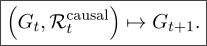
The Law is that a graph’s admissible continuations are fixed by its present structure, and that
realisation selects one of them, which then becomes the antecedent for what follows.
Hypothesis 1.5 (Law of Graphic Equalisation). For realised graph Gt, present graph structure determines admissible continuation structure P(Gt). Interaction and collapse realise successor Gt+1, and that realised successor becomes the antecedent graph for the next local transition. Recursive dynamics are generated by repeated equalisation between present represented structure, admissible transformation, containing constraints, and realised continuation.
A realised deformation is not submitted for entry, so what a containing grammar declines is not
undone by the declining; it stays where it is. That remainder is the residual, and admitting it is the
only route by which a grammar grows.
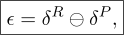
Definition 1.6 (Residual). The residual is
where ⊖ is the grounding’s difference relation preserving relevant discrepancy.
Proposition 1.7 (Residual is what a containing grammar does not admit). Because the graph is a subgraph of its containing frame W, a realised graph-originated deformation is
already a change in W — it is not submitted to W for entry, and there is no step at which W grants or withholds it. The delta is not offered; it is. What the change grammar of W — write it ΓWc, the change face of W’s grammar (Proposition 3.3) — admits coheres with the rest of W and merges into its structure; what ΓWc does not admit is not thereby undone, but remains in place, present and unintegrated. Admissibility sorts a change that already exists; it does not gate one seeking to occur. The residual is exactly this non-admitted remainder:
Corollary 1.8 (Growth is grammar extension). A residual is absorbed either by a containing frame extending ΓWc to admit it, or by paying to copy it out (Section 7 of the long paper (The
frame interface and its economics)); otherwise it persists in place and is re-encountered each time the merge runs. The first route is the substrate form of minting a new distinction: the residual does not fit because it is inadmissible, so admitting it requires extending the grammar, and extending the grammar is the act by which a previously inadmissible deformation becomes recognisable. Recognition and growth are therefore one mechanism joined at one place — the residual is where the shape a graph decodes and the grammar that admits it meet.
Remark 1.9 (Only g is required; the triple is what a running world costs). The triple is not
the minimum. Strip r and Γ and something remains: structure, with relations among its
parts. Nothing happens in it — no transformation, so no collapse, no residual, and nothing it
individuates — but it has not thereby become nothing, and it has not stopped being individuable
by something else. What r and Γ buy is occurrence, and everything this account is about
— change, collapse, observation, cost, experience — requires them. Γ is definitional — an
everything-admitting grammar is still the grammar P is written over (Definition 1.3) — and
what Remark 8.2 calls an optimisation is the restrictiveness of its two faces, not its existence.
The triple is the price of a world in which anything happens rather than the price of there
being anything, and Remark 8.2’s “only that rules run is compulsory” should be read in that
narrower sense.
A distinction is doing the work there. Being a frame is being individuated (Definition 3.1),
and individuation is performed by the container, not by the thing: a boundary belongs to the
frame that draws it. So a structure with no rules of its own is still a frame — something else
instantiated its boundary — and what it lacks is not framehood but the capacity to individuate
anything itself. Stripping r does not leave “no frame”, and reading it so would invalidate the
mind companion’s result, which reasons from a rock’s being a frame to the universe’s being one
(its Proposition 2.1).
What this paper postulates over Is is the ledger of Table 1: named entries, not a count, each with
where it is argued. The prose defending each entry is the long paper’s.
Table 1: The ledger: what this paper postulates over Is.
Status | Entry | Where argued, and what it replaced |
Inherited | Both of Is’s propositions: to be is to stand in relation, and to cohere in it | Is, Propositions 1 and 4. Taking the second adds nothing, since it is derived there from the first plus the measure (Remark 3.10 of the long paper (Coherence, not relation, is the criterion)) |
| | | |
Admitted | That anything happens | Unpaid, and one of two — the other being Is’s claim that there is anything at all |
| | | |
Taken to follow | The transformations r, and Γ with them | Something has to do the happening; the least graph that does anything is a rule.
Two candidates remain open |
| | | |
Postulated | A realisation operator; a destroy/preserve distinction | The attempt to dissolve collapse traded it for union |
| | | |
Not postulated, a consequence | Axiom -1 | Follows from Is’s claim plus the measure (Remark 2.2 of the long paper (The axiom in bits)); guard in this paper, commitment in the groundings |
| |
2 Determinism and sufficiency#
What the Law requires of a transition and what it does not require of the substrate are separate
claims, and both are exposed here: an antecedent has to be there already for a continuation to be
selected from it, the selection adds no primitive randomness of its own, and nothing beyond the three
is needed to carry any of it.
Proposition 2.1 (Antecedent-state principle). The conditions under which a transition is admissible are functions of its antecedent state. A consequence that exists only because a transition has occurred cannot retroactively serve as an antecedent cause of that same transition.
Proposition 2.2 (Graph-law determinism). For a fully specified antecedent configuration—including the graph state, operative transformation structure, admissibility grammar, and every causally operative containing relation relevant to the collapse—the realised continuation is determined:
The Law (Hypothesis 1.5) contains no primitive random actualisation operator.
Hypothesis 2.3 (Minimal graph sufficiency). No parent pointer, world model, affordance catalogue, Narrative, Prospect, Value, or self-model is primitive; such structures may exist in g when the graph actually represents them. Any additional structure required only by a particular capability class is represented content or grounding, not a primitive of graphhood, unless a graph lacking it cannot participate in the basic realised transition relation.
Hypothesis 2.4 (Discrete sufficiency). Every quantity required internally by the present substrate can be represented by discrete distinguishable states at the operative frame and resolution.
3 Frames#
A frame is how anything is reached at all: there is no view from nowhere, so every claim is a claim
made in some frame, and the frame is not a container holding contents but the relation that
demarcates them.
Axiom -1 (Relativity of grounding). There is no operational view from nowhere. Every distinction, measurement, identity relation, admissibility judgement, and represented quantity is made in some frame (Definition 3.1). Frames may represent one another, but no quantity used by the theory requires a frame-independent evaluator.
Definition 3.1 (Frame). A frame is an instantiated boundary relation — the edge BW:G itself, and not the subgraph G it demarcates. The subgraph is the relatum; the frame is the relation.
To individuate is to instantiate such an edge, which is why individuation is per frame rather than a fact about the graph.
Corollary 3.2 (Frame and dimension are one edge type in two roles). A dimension is the same construction read from the other end. The boundary BW:G is a dimension of W — one of the properties along which W separates what it contains — and each dimension W instantiates is a frame to the values it separates. So frame and dimension name two roles one edge type plays relative to another edge, not two kinds of thing, and the asymmetry between them is positional in the same way that the asymmetry between a parent and a child is.
Proposition 3.3 (One interface, two gates). A situated graph meets its containing frame through a single relation, and what an observation from that frame delivers is not distinct in kind from what the containing frame imposes: to a subgraph, being observed is being deformed by its container. That one relation is gated twice, by the same kind of admissibility grammar on its two faces — the aperture grammar Γa on the input and the change grammar Γc on the output:
Γa limits, by grain, which of the container’s deformation enters the rules; Γc determines which of the rules’ realised deltas cohere into the container and which remain as residual (Proposition 1.7). Both are faces of the frame’s one grammar Γ, and instantiate for a specific container W as ΓWa and ΓWc; it is ΓWc, the change face, that the residual proposition uses.
Execution runs between the two.
Definition 3.4 (Aperture). A frame’s aperture is its input gate Γa together with what that gate fixes: which dimensions it can separate along at all, how finely it separates within each (its resolution, per dimension, for which this paper also uses grain), and how far along each it reaches. The three are properties of one edge — existence, grain, and extent — and are named separately because they vary independently, not because they are different kinds of limit. What falls outside an aperture on any of the three is absent to that frame rather than held-but-unresolved.
Definition 3.5 (Change grammar). A frame’s change grammar Γc is its output gate: it determines which of the realised deltas its rules produce cohere into the containing frame and which do not. What it declines has entered the frame and been operated on, so it is residual
(Definition 1.6) rather than absent, and it persists in place rather than being discarded. Γa and Γc are the two faces of one grammar Γ on one boundary edge, and the asymmetry between them is which direction they gate, not what kind of thing they are.
Definition 3.6 (States of a dimension). For a frame F, a dimension is in exactly one of four states:
NULL: the dimension is not instantiated; there is nothing to have a value. Undetermined: the dimension is instantiated and no value has been realised — collapse has not occurred.
Undisclosed: a value has been realised but is not held by this frame. Resolved: a realised value, held.
What a frame’s gates admit, and what it can reach from where it stands, are two quantities and
not one; a disclosure that moves a gate changes what the gates admit, and that is where an
information hazard is located here rather than treated as a class of its own.
Definition 3.7 (Capability and accessibility). A frame’s capability is what its gates admit —
what it can represent and what it can do. Its accessibility is what it can reach from where it stands, given what it holds to spend. A disclosure moves a gate and changes capability; whether the reachable point can then be crossed to depends on the Narrativium measured for the frame.
Narrativium, which defines that quantity, types it as a capacity rather than as a cost (its Remark 1.1), and keeps measurement and expenditure distinct; the phrasing here follows it.
Definition 3.8 (Information hazard). A disclosure changes admissibility when it moves a frame’s aperture gate, its change grammar gate, or both (Proposition 3.3), and what it changes when it moves one is that frame’s capability (Definition 3.7). An information hazard is a capability change whose negative sign is admissible in the reference frame, above the point at which the impact forces a write. The class is disclosures that change admissibility; the sign is applied afterwards by a frame with preferences, and the magnitude is a ratio to what the frame can absorb rather than an absolute.
Proposition 3.9 (The threshold is a ratio, and sits where the impact forces a write).
A minimum magnitude is required, or every capability change would be a hazard. The threshold cannot be an absolute, since an absolute would be a magnitude fixed independently of any frame, which Axiom -1 forbids; it is a ratio — impact against the scale of the frame bearing it. And the substrate supplies where the ratio sits rather than leaving it to stipulation: the threshold is
the point at which the impact forces a write. An impact a frame can absorb coheres with what it holds, forces no write, and costs it nothing; an impact it cannot absorb leaves residual and compels change. That is the same line every other quantity here is measured against, and it is a ratio by construction, because absorption capacity is the frame’s own.
4 Identity#
Sameness is not read off the substrate. It is fixed by whatever frame individuates, which leaves two
identity relations where ordinary usage has one — the graph’s own continuity with what produced it,
and the tracking a container does of a situated instance.
Theorem 4.1 (No frame-free identity). The substrate alone does not determine whether two represented instances are the same graph independently of an individuating frame.
Definition 4.2 (SELF identity). SELF identity is the continuity of the graph as a whole —
its rules together with the state they act on — across realised transitions. A graph is the same self while its present remains congruous with its own history: if its rules changed abruptly, the structure carried forward would no longer cohere with what produced it, and that incongruity is the discontinuity. Represented self-description — content inside g by which a graph identifies itself — is one optional part of this and not the whole of it; a graph may have SELF identity without representing itself at all.
Definition 4.3 (SUPERGRAPH identity). For graph G individuated in frame W,
is the identity relation under which W tracks that situated instance.
5 Economics#
Cost characteristically attaches to writes rather than to holding, and what a write costs is set by
whatever runs the rules rather than by any universal. A graph changes itself directly and its container
only as the region of it that it is, so the distribution of what is free, what is costly and
what is directly writeable is a characterisation of a common configuration rather than a
necessity.
Proposition 5.1 (Cost characteristically reduces to the write). In the substrate as characterised here, the boundary relation itself is free, and the standing structure persisting is free to the frame; the operation that costs is a delta that writes over that structure, and r is what writes. Whether persistence is free simpliciter is set by the rules of the superframes, which may sustain a frame without charge or require a write to keep it standing, and the substrate does not decide between them. Free here means information-preserving rather than absent: evaluating a rule is itself a write, and is unpaid because it destroys nothing (Remark 7.17 of the long paper (Where the check goes, and why the free case is the empty one)). To that extent
Proposition 5.2 (Self-change is direct and gated; a graph is a subset of its container).
A graph changes itself and its subgraphs directly. Self-change is real, but it is rule-governed, with its own cost and limits (an instance of the non-uniform writeability of Remark 5.3); a substrate’s plasticity is exactly the rules for how its rules may change. What a graph does not
do is change its container directly: the container applies deformations to it — being observed is
being so deformed — and gates its changes through its own change grammar (Proposition 1.7).
But a situated graph is a subset of its container, not a thing set against it, so a self-change is already a change in the container, in the region that is the graph, propagating outward through whatever couples it to the rest.
Remark 5.3 (Writeability status is contingent, not uniform). The write-economics stated here
— reads free, cost carried by writes, and no direct alteration of the container (Proposition 5.2)
— should be held at the strength the evidence supports, and the two halves of that need
separating. The structural claim — that a graph affects its container as a subset of it and
not by some other route — is a strict restriction and is committed to as one (Section 19 of
the long paper (Falsifiability commitments)). What is a pattern rather than a universal is the
distribution below: which writes are free, which are costly, and how much is direct. What is
freely writeable, what carries a cost, and what a graph can write directly rather than only
across a boundary, need not be uniform; different structures may have different writeability
profiles. The strict forms above characterise a common and efficient configuration (Remark 8.2)
rather than a necessity of graphhood, and asserting a single strict write-economics everywhere
would be the same over-specification Remark 8.2 warns against, a fixed value put where the
account has only a setting. These are accordingly carried as falsifiability commitments, open to
counterexample, and a structure with a different writeability profile refines the characterisation
rather than breaking the substrate.
Definition 5.4 (Well-formedness). A graph is well-formed to the degree that it pays for nothing that does no work for it. Four costs bear on that and they behave differently, so the notion is graded along each rather than binary.
Writes are paid when made (Proposition 5.1), which prices doing. Retention is nearly free per unit, which is why an unused distinction is not immediately pruned. Search is paid on every operation over what is held and scales with how much is held, so inert structure is cheap to keep and expensive to keep in quantity.
The fourth is the worst and is not a variant of the third. A write may land on structure that cannot affect anything — a modification to a branch nothing reaches. It is paid in full: decided, made, checked, risked. It returns nothing. And unlike a search, which is expensive and then yields, this failure is silent: the graph has spent, has no effect to show for it, and no signal that the effect is missing. What it acquires instead is a false model of itself, in which something was changed that was not — residual it cannot see, produced by its own inert contents, and the share of writes exposed to it grows with how much is held.
Proposition 5.5 (Evaluation is a write, and free because information-preserving). A read is an operation that returns a datum; the returned datum has to be somewhere to be used, and in a substrate that is graph all the way down there is no return channel outside the structure, so the value materialises as structure and the write is the return. Evaluation is a write in that plain sense: a match outcome, a position in an ordering, and the fact of having tried are returned values, and returned values are structure. It is nonetheless unpaid, because it destroys nothing —
free here means information-preserving rather than absent. What it costs does not follow from that: a rule’s cost is set by whatever supplies its primitives and is inherited along provision, so reversibility is a structural fact about a map while cost is a fact about what supplies a primitive, and the two must not be run together.
Proposition 5.6 (Primitives leak, and complete provenance is still unrecoverable).
A primitive discloses the structure beneath it: leaking is ordinary rather than exceptional (Remark 14.2 of the long paper (Exposure is excluded; leakage is produced)). What does not follow is that provenance can be recovered entire. Every act of recovery is itself performed by primitives, so a graph inferring what lies beneath one operator does so using others whose own provenance is not thereby in view, and there is no position from which the whole supply is inspected at once. The result is the standing shape: partial always, complete never — leaks give a graph real and sometimes decisive knowledge of what supplies it, and never the closure of that question.
6 When a write is refused#
An inadmissible write yields no continuation in that frame. What happens after that — whether
anything propagates, whether a value is produced instead — is rule content and not substrate. The
failure itself does not vary; the frames do, and a handler is an installed policy rather than a discovered
semantics.
Proposition 6.1 (Decoherence is one operation; the frames are what differ). Decoherence is one operation. It does not come in kinds and it does not come in degrees, and the two cases above fail identically. What differs between them is the frame — arithmetic in one, kinematics in the other — and the frames are what make the cases different, not the failure. “Everything in the superframe” is a constant expression whose value is frame-relative, which is Axiom -1
applied to incoherence rather than to observation.
Proposition 6.2 (A handler relocates a failure; it does not close it). A handler is installed policy that determines what a frame coheres a refused write to, and it can be set to cohere it to anything, including success. Swallowing does not undo the inadmissibility: the containing grammar still refused and the write still did not happen, so what is removed is the frame’s record
of the refusal rather than the refusal. Detection is available and never free — a frame holding a record of the attempt separately from the handler’s report can compare the two — but it is unavailable from the handler’s own report, which is self-consistent by construction. The audit is therefore installed structure, and being itself a policy it is abusable in the same way one level in, so what its purchase buys is relocation rather than closure, terminating only in a containing frame.
Proposition 6.3 (Dependents are held by the referring frames, not the referent). A thing does not carry a record of what depends on it: the dependencies live in the frames holding the references and not in the referent, so from the position of the structure being removed they are not visible at all, and knowing what would break requires the containing frames. Removal therefore yields three states rather than two. Absent — nothing ever cohered, nothing is held and nothing owed, and it is free. Vacated with the references left standing — a hole, unpaid, with consequences determined by whatever the dangling relations do next. Vacated with the absence
represented — a tombstone, a cascade rule, a retained count of dependents — which resolves cleanly and is installed machinery paid for under Proposition 5.1.
Proposition 6.4 (Termination propagates along supply, not containment). Being contained by something and being run by it are two relations, and they need not coincide. Termination propagates along the supply relation and not the containment relation: downward it need not reach at all, a container being able to stop while what it held runs on, and upward the supplier’s stop is total, at whatever containment distance and with no handler available, since the operations a handler would run are the ones withdrawn. This splits the dependents of a stopped structure into three kinds rather than two. A dependent that merely refers to it is left dangling and keeps running, wrongly; a dependent wholly run by it simply stops; and a dependent only partly supplied by it keeps running with an incomplete operation set, and its behaviour is undefined.
Proposition 6.5 (A boundary is known only by crossing it). A frame that never fails discloses nothing about what it admits. Admissibility is invisible from inside its own range, since everything works, and the boundary is legible only where it is crossed — so the way to learn a rule is to force the failure and read the residual. The test and the change are accordingly the same operation: knowledge of a boundary is bought by crossing it, and there is no cheaper instrument. It follows that every handler installed reduces what failure can teach, a frame that coheres its failures to tidy values reporting success and disclosing nothing, so that robustness and legibility are traded against one another rather than being two names for quality.
7 Time#
Time is not a substrate dimension. It is inferred by a frame from its own closure cycles, so a frame
with no closed loop has none, and what the past contributes is only whatever of it is still standing
now.
Axiom 1 (No substrate time dimension). Time is not a first-class dimension of the substrate.
What the substrate has is change: realised collapses. It has no ratchet over and above them — no mechanism that manufactures succession — because the three properties usually bundled under that word are readings over changes or properties of them, not a further thing the substrate runs.
The ordinal event order of Section 11 of the long paper (Causal order and local time) is carried by the changes’ own enabling-relations; direction is the asymmetry of enablement itself — if one change makes another possible, the second does not thereby make the first possible, which holds whether or not a change preserves what it followed; and persistence is only that further changes occur. A time dimension exists only where a frame instantiates one to represent that order.
Proposition 7.1 (Time is inferred, not observed). No collapse presents a temporal coordinate. Succession is a relation between realised states, and a relation between states is not a datum of any one of them. A frame therefore acquires a time dimension only by inferring it from the relations among what it holds. Consequently
Proposition 7.2 (The unit of inferred time is a cycle, and requires closure). A frame does not count its individual changes — those are below its aperture — but its own cycles, each one traversal of a closed rule-loop. The unit of inferred time is therefore a cycle, not a change, and a cycle has no fixed length: each does a variable amount of change, so inferred time is non-uniform in underlying change (a nonlinear grounding, which Hypothesis 2.4 already permits) and a fuller cycle reads as a longer moment (subjective dilation). A cycle exists only for a graph with closure
— a graph without it runs to fixed point once and stops, one pass and no repeated tick — so having time requires closure as well as inference (Proposition 7.1): a one-shot computation, lacking a loop to iterate, has no time, and a frame’s experienced “now” is one cycle of its own loop.
Definition 7.3 (The present, structurally). Within a frame, the present is the collapse boundary at which every instantiated undetermined dimension relevant to that collapse has been determined:
UF counts undetermined dimensions only. NULL dimensions are excluded — they are not variables. Undisclosed dimensions are also excluded: they are already determined, and a frame’s failure to hold them is an epistemic deficit rather than an unresolved collapse. A frame with outstanding undisclosed structure is still at its own present.
Proposition 7.4 (No implicit historical state). A previous success, failure, attempt, or residual has no later causal force merely because it occurred. It affects later dynamics only insofar as its consequences are present in later graph or boundary state.
Corollary 7.5 (History principle, strengthened).
The past is surviving consequence instantiated now, not a stack of still-existing historical frames.
8 Primitives, and the single prohibition#
Definition 8.1 (Primitives). A graph’s primitives are the operations it invokes without performing: the operator set its rules bottom out in. Every level has them, and having them is what being a level consists of — a graph with no primitives would have to perform everything it invokes, which is the regress this substrate does not contain. That is the whole of the definition, and in particular it says nothing about what a graph can learn of where they come from.
Remark 8.2 (What is required and what is optimisation). Only that rules run is compulsory
for anything to occur — structure alone is what is required for there to be anything at all
(Remark 1.9). Applying a delta is itself a rule, not a primitive operation beneath the rules, so
the specific dynamics — inertia, the merge behaviour, closure — are contingent rule content,
and a different r or Γ is a different physics rather than a violated law (this is why the initial
and boundary conditions of a grounding are supplied separately from its laws; Section 11 of
the long paper (Causal order and local time)). The two gates of Proposition 3.3, and even the
retained standing structure itself, are optimisations on bare rule-running: the aperture grammar
Γa bounds the input, the change grammar Γc sorts the realised output into what coheres and
what is residual, and the retained structure buys free continuation. A substrate whose grammar
admits everything still runs — effectively ungated, without momentum, wastefully. It is not a
substrate lacking Γ, since Definition 1.3 defines the possibility structure through the grammar
and a collapse needs something to select from. The two gates are accordingly what an efficient
graph accretes under a budget, not constituents of graphhood. The retained structure specifically
is what distinguishes a self-sustaining loop from a purely reactive one, since coasting is the
cached structure.
Proposition 8.3 (Primitives are supplied, not intrinsic). A graph is data — nodes, relations, and rules — and the operations its rules bottom out in are supplied to it rather than contained in it. The same graph may therefore be run against different supplies of the same operator set, and nothing supplying an operator need be the substrate the graph describes or is “in.” Where the work is done is a fact about that supply and not about the graph.
Proposition 8.4 (A well-formed runner does not expose itself, and no level is self-transparent).
The asynchronous, locally synchronous structure a frame observes (Remark 11.3 of the long paper (Globally asynchronous, locally synchronous)) is the graph’s internal view and does not fix its runner’s actual mode. Where a frame has no boundary to the substrate that runs it, its runner lies beyond the frame’s epistemic boundary (Section 1 of the long paper (Scope and epistemic
status)); a hidden runner may execute the graph serially while the graph appears asynchronous to itself (Remark 11.3 of the long paper (Globally asynchronous, locally synchronous)). And no level is self-transparent: reading is an operation whose product lands one level up (Remark 7.17 of the long paper (Where the check goes, and why the free case is the empty one)), so a level cannot hold the reading of itself while being the level that is running — a frame may be given sight of what runs it and cannot be given sight of its own running.
Proposition 8.5 (A primitive is another graph’s running, exposed). Nothing supplying a primitive is a substance apart from graph data. An operator is the observable running of some other graph, which has primitives of its own, supplied in the same way. A graph’s “primitives”
are therefore the observable running of other graphs, exposed as an operator set, with no primitive runner at the base. The regress bottoms not at a floor but at the epistemic frontier of Section 1 of the long paper (Scope and epistemic status): below the lowest measured level is the unclaimed pre-relational substrate.
Stepping back: the account forbids very little, and what it does forbid is one thing recurring rather
than a list.
Proposition 8.6 (The single prohibition). The account forbids one thing: a frame cannot get
outside itself. Concretely, and confined to what is actually derivable here, it takes three forms.
A frame cannot be transparent to itself at the level it is running at (Proposition 8.4). It cannot measure its own throughput in units independent of it, since the measurement is funded by the throughput — which leaves a number obtainable and its absolute scale not. And it cannot hold a view from nowhere, which is Axiom -1.
That prohibition has a formal analogue — a language of sufficient strength cannot define its own
truth predicate, and must be given it from a metalanguage — and the analogue is proved, though the
mapping from frames to formal systems is argued rather than proved. What is forbidden is complete
self-capture and not partial self-modelling, which is why reflective towers work and a frame can know
a great deal about itself. Two candidates are deliberately not on the list: that a frame cannot obtain a
quantity whose unit does not close within it is contingent rule content, and that a frame
cannot decide anything without writing is a pattern of the write-economics rather than a
universal.
9 Carvings#
Since the rules draw the boundary and the rules are contingent, no carving is privileged. That does
not make the notion vacuous: an ill-formed cut costs more writes, so a frame under a budget tends to
be running cheaper cuts, and what looks like a joint is where the cheap cuts of frames doing shared
work coincide. The step from shared work to similar cuts rests on a posit, labelled here as
one.
Hypothesis 9.1 (Near-uniqueness of the cheap cut). For a given task under a given binding constraint, the cheapest arrangement that performs it is nearly unique. This is an empirical posit and not a result of this account: nothing here derives it, and what is available without it is weaker — a binding constraint narrows the solution space, and the more binding it is the narrower it gets.
Proposition 9.2 (Convergence is observed, not enforced). Two frames doing the same work converge on similar cuts as each becomes better formed, because the cheap cut for a given task is nearly unique. This is a tendency of cost and not the discovery of a privileged boundary, and the two are distinguishable in principle: a privileged boundary would enforce convergence, and enforcement would extend to the hard cases; cost-shaped cuts converge where the work is shared and come apart where it is not. The step from shared work to similar cuts assumes Hypothesis 9.1.
Proposition 9.3 (Convergence under compression). A structure operating under a constraint, and under pressure to spend nothing on what does no work, approaches the arrangements that constraint forces — asymptotically, and only over the region the constraint touches. Two such structures therefore come to resemble each other without either having access to the other, because both are downstream of the same forcing rather than converging on a target.
Hypothesis 9.4 (Located degradation). Where a classification’s purpose can be specified independently and in advance of inspecting its failures, the failures concentrate near the boundary of that purpose more than a uniform distribution over the domain would produce. The claim is comparative and is not that failures occur nowhere else.
10 Falsifiability#
The substrate risks little by design and the groundings carry the risk. Below are the commitments
attached to the material this statement carries. They are a subset: the long paper carries the full set,
including those for results not stated here, and the omitted commitments are listed below by title, so
the omission stays visible rather than becoming a claim.
-
1.
- [shape] Composition. Prior to the component commitments below: the arrangement claim
of Section 1 of the long paper (Scope and epistemic status) fails if the structure’s recurrence
across unrelated domains is an artefact of description rather than a property of those domains.
Evidence against it would be a demonstration that any sufficiently rich domain can be
rendered in this vocabulary with equal facility, including domains chosen adversarially to
lack the structure. Evidence bearing on it is independent re-derivation, in a domain’s own
idiom, without reference to this theory — which rules out this vocabulary having supplied the
structure, and does not by itself distinguish the composition claim from the shared-constraint
reading the account predicts anyway. The burden here is deliberately on the negative side,
because that side is closeable: a single adversarial domain rendered with equal facility settles
it against the claim. No requirement is placed on the positive side to exhibit domains that
share nothing — every pair of domains shares something, so that standard is unmeetable
in principle, and discharging it would mean enumerating domains until an assessor chose to
stop. A test whose stopping condition lies with the assessor rather than with the claim is not
a test, and this paper does not offer one.
-
2.
- [shape] Minimal graph sufficiency. Fails if basic realised graph dynamics require a
primitive beyond (g,r,Γ) rather than represented or relational structure (Hypothesis 2.3).
-
3.
- [shape] Discrete sufficiency. Fails if a claimed observable consequence cannot be
preserved by any discrete representation, including dynamically varying quantisation, but is
preserved by a genuinely non-discrete primitive (Hypothesis 2.4).
-
4.
- [shape] Antecedent-state principle. Fails if a realised transition can require as
antecedent a fact that exists only as consequence of that same transition, absent prior
fixed-point structure (Proposition 2.1).
-
5.
- [shape] Graph-law determinism. Fails if two genuinely identical, causally complete
antecedent configurations produce different realised successors without any additional
causally operative distinction (Proposition 2.2). Variation observed only from a frame that
omits determining dimensions does not constitute such a falsification.
-
6.
- [shape] No implicit historical state. Fails if an unrepresented past event alters later
transition structure despite leaving no causal trace in graph or boundary state.
-
7.
- [shape] Frame-relative identity. Fails if sameness and persistence are derivable from
(g,r,Γ) alone without individuation.
-
8.
- [detail] Located degradation. Fails if, for classifications whose purpose is specifiable
in advance of inspecting their failures, failure cases are distributed no differently near the
purpose boundary than across the rest of the domain (Hypothesis 9.4).
-
9.
- [shape] Convergence is not enforced. Fails if convergence between independently
developed classifications of one domain extends to the cases where the classifications’
purposes differ, which is what a privileged boundary would produce and cost-shaped
convergence would not (Proposition 9.2). Marked [shape] because a privileged boundary is
not a mechanism this account could replace, since the contingency of the rules that draw a
boundary is what Section 16 of the long paper (Carvings, and why classification degrades)
rests on and what Axiom -1 asserts one level up. Exhibiting one costs range rather than a
mechanism.
-
10.
- [shape] Provenance is never closed by inference. Fails if a frame can settle the
provenance of its own operator set from inside: if some in-frame procedure establishes, rather
than merely evidences, whether its operators are self-supplied, how many distinct structures
supply them, or whether a serial hidden supply underlies an apparently asynchronous frame.
Not that primitives fail to leak — they do, and Proposition 5.6 says so. This is the single
prohibition (Proposition 8.6) in operational form, argued in Section 15 of the long paper
(The single prohibition, and its formal core).
-
11.
- [detail] Solutions are nearly unique under a binding constraint. Hypothesis 9.1,
the posit under Propositions 9.2 and 9.3. Fails if structures optimising hard against the
same binding constraint, over the same region, are exhibited arriving at arrangements that
do not resemble each other — in which case constraint narrows the space without selecting
within it, and both propositions weaken to that.
-
12.
- [detail] Cost is the write. Fails if the boundary relation itself, or the retention of standing
structure, carries an irreducible cost that is not any write’s — a frame charged for holding
its boundary open, or for keeping structure standing, where no delta is written and none is
occasioned. Those two are the non-write costs Proposition 5.1 itself names as free, so they
are where the claim is exposed; reading is not the test, since a paid read is a write here
(Proposition 5.5) and the falsifier would be absorbed rather than met. Marked [detail]
because Remark 5.3 already carries the distribution of costs as a pattern rather than a
universal: a structure with a different writeability profile refines the characterisation rather
than breaking the substrate.
-
13.
- [shape] Self-change is subset-change. The claim is that a graph changes itself and
its subgraphs directly (rule-governed), and affects its container only as a subset of it, by
propagation through coupling. Fails if a graph changes its container by a means other than
changing the region of it that the graph is — a container-change not propagating from the
graph’s own subset — or if a container-supplied graph can self-terminate without acting on
the container (Corollary 10.7 of the long paper (Severing the channel removes termination));
a self-supplied graph stopping itself is not a counterexample, being the case that corollary
excludes.
-
14.
- [shape] Minting is a rule. Fails if grammar-extension (growth) requires a primitive
operation beneath the rules rather than a reflective rule subject to the same economics,
admissibility, and antecedent-state principle (Proposition 2.1) — in particular, if a graph
can mint its first distinctions without any seeded from its container.
-
15.
- [shape] Residual is inadmissibility. Fails if a graph-originated deformation can be left
as residual by a containing frame that nonetheless admits it under ΓWc, or absorbed while
inadmissible, so that residual and non-admission come apart.
-
16.
- [shape] Realisation is single-valued. Fails if realised dynamics are better accounted for
by retaining the admissible set than by selecting one member of it — and the qualification
is the whole test: a treatment carrying all continuations forward must recover the observed
statistics from the retained structure without adding a measure over it to do so, since retention
that needs a weighting has reintroduced selection under another name.
-
17.
- [shape] No-copy (the destroy/preserve postulate’s exposure). Fails if a substrate change
can preserve its predecessor without paying to keep it — if retention is available at no cost
rather than as a purchased record. What is at stake is the Landauer reading of Section 7
of the long paper (The frame interface and its economics), which requires change and
irreversible operation to coincide. The arrow of the event order is not at stake, though it
is easily thought to be: direction is carried by the asymmetry of enablement, which stands
whether or not a change preserves what it followed.
-
18.
- [shape] Decoherence is one operation. Fails if the manner in which an inadmissible
write fails is a property of what was attempted rather than of the frame’s rules — that is, if
one frame under one rule set yields structurally distinct failure modes for two inadmissible
writes, with the difference not attributable to that frame’s own policy (Proposition 6.1).
Different outcomes across different frames do not bear on this; that is what the claim predicts.
-
19.
- [shape] A swallowed failure is relocated, never closed. Fails if a frame can settle from
inside that a swallowed failure went nowhere, rather than relocating the question to what it
cannot inspect (Proposition 6.2). Not that a frame cannot detect its own handler discarding
a failure — it can; the exposure is the settling. One of the four places named below at which
the same event would be found.
-
20.
- [shape] Dependents are not held by the referent. Fails if realised graph dynamics
require a structure to carry the set of things depending on it — back-references primitive
rather than installed — so that the consequences of removing a structure are recoverable
from that structure alone, without querying the frames holding the references and without
paid machinery (Proposition 6.3, argued at Remark 9.14 of the long paper (What never cohered is absent; what cohered and stopped leaves a hole)). A substrate in which deletion is
always clean falsifies this, and would also remove the distinction between an absence and a
vacancy.
-
21.
- [shape] Termination follows supply, not containment. Fails if containment alone
determines it — if a subgraph must stop when the graph containing it stops, even where its
primitives are supplied from beyond that graph (Proposition 6.4). The partial case carries
its own clause: fails if a frame losing part of its supply must either stop or continue correctly,
rather than running with an incomplete operation set and undefined behaviour, or if such a
frame can enumerate what it has lost from inside — which would also falsify the provenance
commitment below.
-
22.
- [shape] A boundary is known only by crossing it. Fails if a frame can settle the
location of its own admissibility boundary without any write that crosses it. Extrapolation
from inside the admissible region evidences a boundary and is not at issue; establishing
one would be (Proposition 6.5). This is the epistemic member of the same family as the
provenance commitment below, and fails in the same manner — by a procedure that closes
the question rather than relocating it.
-
23.
- [detail] Robustness trades against legibility. Fails if a policy can bound a frame’s
residuals without reducing what its failures disclose about its grammar — a handler that both
absorbs and reports with no loss (Proposition 6.5, argued at Remark 9.12 of the long paper
(Forcing a failure is the instrument, and handlers blunt it)). Cheaply testable in software,
and marked [detail] because the account survives its loss with the trade weakened to a
tendency.
-
24.
- [shape] Capability and accessibility are distinct. Fails if what a frame’s gates admit
and what it can reach from where it stands collapse into one quantity — if there is no case of a
frame able to represent and perform an arrangement it cannot reach, or none of a frame able
to reach what it cannot represent (Definition 3.7). The coupling claimed between them, that
a capacity shortfall narrows aperture and so degrades capability over time, fails separately
if aperture width is unaffected by demands on capacity.
-
25.
- [detail] A hazard is a signed capability change above a frame-relative threshold.
Fails if a disclosure can be a hazard to a frame in which the negative sign is not admissible,
or if the magnitude at which one counts is fixed independently of the frame bearing it rather
than as a ratio to what that frame can absorb. Fails also if the threshold sits somewhere
other than where the impact forces a write.
-
26.
- [shape] The relativity of grounding is a consequence, and can fail as one. Fails if
a view can be informative without standing in relation to what it views, or if relation is not
what carries information here. A consequence has content and can fail, which a posit or a
costless guard could not (Remark 2.2 of the long paper (The axiom in bits)). The second
disjunct is Is’s own identification of distinction with relation, so this is where the account is
thinnest rather than where it is safest, and it is marked [shape] because what fails with it
is the range of everything derived through it.
Not carried in this statement: A held program is one write; Coupling is a setting, not a kind; Two
gates, and absence is not residual; Partial-order sufficiency; Globally-async/locally-sync; Time is
inferred, not primitive; The unit of inferred time is a cycle requiring closure; A cycle count is one-way;
phase is signed; Externalising lengthens the interval before a crossing is legible; No free lunch;
Description length is constitutive, not merely a method.