
Graphic Equalisation requires only admissible continuation and deterministic collapse. It does not require a graph or containing frame to represent unrealised futures as an object. This paper studies the additional structure that appears when a frame represents the futures that remain distinguishably reachable under counterfactual admissible interventions and represented future boundary conditions. The resulting object is the Seldon manifold: a frame-relative, horizon-relative, resolution-relative representation of reachable future state or history.
The construction is deterministic at substrate level. A Seldon manifold is not a probability distribution over multiple outcomes of one causally complete antecedent. It is a representation of different deterministic continuations obtained under different admissible interventions, future interactions, or unresolved containing conditions represented by the frame. If all causally relevant future conditions and interventions are fixed, the represented continuation collapses to one trajectory.
The manifold need not be smooth or continuous; “manifold” denotes structured reachable geometry. Its dimensions are instantiated only where represented, its values are discrete at operative resolution, and its quantisation may change dynamically. Two distinctions are developed at length: what such a projection is a projection over — the undetermined, which collapse has yet to fix, as against the undisclosed, which is realised but not held by this frame — and causal depth, the additional determining structure supplied by containing frames rather than by earlier times. Goals, where represented, define acceptable subsets; Muchness measures retained distinguishable future possibility; irreversibility removes reachable distinctions; and control deforms the reachable geometry. No primitive is added to graphhood.
Before the construction, a boundary on what is being described and what is being claimed of it, because the abstract’s phrasing invites a reading stronger than the position of this paper.
Remark 1.1 (The object is described, not proposed — and millions read one daily). A Seldon manifold is a description of something that exists, and an implementable one. It is not machinery proposed for a frame to adopt, and that the sections below build it up from the substrate should not be mistaken for a claim that it was invented there.
The simple case is read by millions of people every day. A hurricane forecast cone is a time-indexed set of reachable continuations, drawn in one frame, widening with lead time because information about later slices is worse; the National Hurricane Center’s version is sized so that the storm’s centre has historically fallen inside it about two thirds of the time (National Hurricane Center, 2026). Nobody using it reads a trajectory off it. They ask whether a position stays inside the envelope over the horizon they care about, which is exactly the question the rest of this paper formalises. A route planner’s arrival estimate is the same object with the cost field foregrounded — reachable arrivals under a cost re-projected as the present moves — and a weather forecast, a budget projection and a calendar are readings of one.
That the cone is routinely misread as the extent of the storm rather than as the envelope of its centre is not an aside. It is a frame confusion of the kind this paper treats: one quantity’s manifold read as another’s, with the error invisible from inside the reading.
Two consequences for how this paper should be taken. The contribution is not the manifold, and claiming it would be false — the object is ubiquitous and every case above predates this account. What is contributed is that they are one object: the same structure with its fields named rather than left implicit, indexed to the frame holding it rather than treated as a view of the future, and specified closely enough to be built. And a paper describing something that exists is answerable to how that thing behaves.
Remark 1.2 (Ubiquitous, well named, and underspecified everywhere — and why that is the expected state). The previous remark invites a question it should answer rather than leave hanging: how can something be this widely used and this little formalised? The tempting answer is that it went unnoticed, and that answer is wrong. The object is not unnamed. It is underspecified.
It has been named repeatedly, once per domain and often well — a cone of uncertainty, a reachable set, a viability kernel, a belief space, an arrival estimate. Each of those is a good name and none is hiding. What none of them carries is a specification complete enough to leave its domain: a cone is specified to the point a forecaster needs and no further, an arrival estimate to the point a router needs and no further. The instances are locally complete and generally incomplete, which is a different condition from being unobserved and has a different remedy.
Underspecification also has an operational test where obscurity has none, and it is this paper’s own: a specification is underspecified exactly where you cannot build from it. One cannot construct a route planner from the definition of a hurricane cone, nor a viability kernel from an arrival estimate, though all three are the same object under different fields. That is checkable rather than rhetorical, and it is the sense in which the general form is missing while the instances are not.
Why it stays that way follows from the substrate rather than from anyone’s inattention. A frame pays for nothing that does no work (Graphic Equalisation’s well-formedness condition, Definition 7.13), and generalising a structure one already handles correctly is a write that returns nothing locally. The meteorologist does not need the general form; neither does the routing engineer; both are right to decline it, and a discipline that spent on it would be carrying structure that does no work for it. The general form is worth its cost only to someone who has to cross domains — which is uncommon, and which predicts both the state of the literature and the kind of person who changes it. Where the general form of some equally ubiquitous quantity has arrived, it has tended to arrive from someone crossing rather than from within a domain that had a working local version.
One guard on all of that. None of it is a claim that the domain treatments are deficient — they are correctly scoped, and this account has no standing to improve a forecast.
The remaining point concerns obviousness, and obviousness is a signal worth having rather than evidence of nothing. Reading as though anyone could have written it, while not having been written, is the success condition for a description rather than an embarrassment about it. The two halves are worthless apart and diagnostic together. Obvious and already written is restatement. Unobvious and unwritten is as likely to be wrong, or to be a proposal nobody required. But a statement that a reader recognises immediately has passed the test that matters for description — recognition is what distinguishes describing a thing from imposing a model on it, and a description that surprises its readers is the one to check first.
This account can say why the pairing occurs rather than merely welcoming it. A cheap cut looks like a joint once it is found (Graphic Equalisation’s carvings result, Proposition 16.2), so a good compression reads as inevitable in retrospect — and cheap cuts are hard to reach for exactly the reason they are cheap, since nothing points at them while every local version already works. The effort is accordingly asymmetric: substantial to arrive at, nearly free to check. That asymmetry is characteristic of compression and is what the pairing looks like from outside.
The third leg is still required and is not supplied by the other two, since a statement can be obvious and unwritten because it is useless. What rules that out is the same thing as before: whether the general form does work the local ones cannot, meaning transfer between domains and buildability.
A manifold is built and not found. What Definition 6.1 names is a representation a frame constructs, not a structure the world contains, and the construction is what makes it a device: a frame holding one can shape which futures stay reachable rather than only discover which are. That is also what makes the grounding question well formed. Asking whether some system has a Seldon manifold treats it as a natural kind and gets nothing; asking whether a system implements anything of this shape, and at what fidelity, is answerable, and is the form the Seldon grounding takes (its Section 1).
Remark 1.3 (Succession does not require an observer). Realised change, and the succession its enabling-order carries, exist independently of any frame representing them. Graphic Equalisation withholds even a ratchet-mechanism over the changes — succession is a relation carried by which change enables which, not an engine the substrate runs — but that order is substrate-level regardless of any observer. Seldon manifolds, by contrast, are optional observer or agent machinery for representing reachable unresolved continuations. Nature does not have to run a Seldon manifold in order to evolve.
Remark 1.4 (The horizon is doubly observer-relative). The horizon h is not a substrate quantity. By Graphic Equalisation’s Axiom on time (Axiom 1), the substrate has succession and no time dimension; a temporal dimension exists only where a frame instantiates one to represent that succession. So h is measured in a dimension the observing frame constructed, and indexes a manifold the same frame constructed. Both the ruler and the thing measured are observer machinery, and neither is a claim about what the world contains. Empirical temporal evidence is not introduced here as evidence for the construction: the psychological grounding reports the measured motor delay horizon (its Section 2), timing-based resolution scaling (its Section 5), and plural neural horizons (its Section 6) as component-specific implementations with their own limits.
Remark 1.5 (Higher machinery is frame-relative, not substrate-required). The same holds of every construct in this paper and its successors: manifolds, undetermined counts, inferred futures, Narrative, and Narrativium are first-class quantities only in frames that instantiate the relations defining them. They are not universal substrate requirements, and their absence from a frame is not a deficiency of that frame’s dynamics.
These remarks are load-bearing for the falsifiability commitments in Section 22: a claim about what an agent’s representation supports is not a claim about what the world must contain.
Reachable sets, viability kernels, capture basins, invariant sets, dynamic programming, Hamilton–Jacobi reachability, and model-predictive control are established parts of control theory and applied mathematics (Bellman, 1957; Aubin, 1990, 1991; Mitchell et al., 2005; Bansal et al., 2017; Rawlings et al., 2017); this paper claims none of them as new, and its contribution is their placement inside the Graphic Equalisation frame architecture, stated in full in Section 21.
Reading for the claim. As in Graphic Equalisation, the components used here are individually established and cited as such; the claim is their arrangement, which is not reachable by evaluating those components separately, since they are stipulated to be known. The composition’s own falsifiability commitment is stated in Graphic Equalisation and is inherited here.
Let
be a realised graph in individuating frame Wk, and write

Graphic Equalisation supplies a deterministic realised transition once the causally complete antecedent configuration is fixed. It also distinguishes immediate admissible possibility from realised collapse:

This paper asks what follows when a frame represents recursively reachable continuations over a horizon rather than only the realised next step.
Proposition 4.1 (Deterministic reachability). A Seldon manifold does not require stochastic substrate dynamics. For a fixed causally complete antecedent configuration and a fixed future sequence of admissible interventions and containing interactions, Graphic Equalisation yields one realised continuation. Multiple points or histories in a Seldon manifold correspond to different counterfactual future conditions represented by the frame, not multiple random outcomes of one identical complete cause.
Let u = (ut,…,ut+h−1) denote an admissible intervention sequence and b = (bt,…,bt+h−1) a represented sequence of future boundary conditions or containing interactions. For a deterministic transition law T, a future history is generated recursively by

The frame need not know which b will be realised. Its uncertainty about that sequence may be represented probabilistically if useful, but probability is an epistemic overlay on the reachable family rather than a primitive of the Graph Law (Graphic Equalisation’s Hypothesis 5.1). The manifold itself is the deterministic family of continuations indexed by the represented interventions and containing conditions; a probability model is only one frame’s summary of which member it expects to encounter.
Corollary 4.2 (Singleton under complete fixing). If the frame fixes the causally complete antecedent, all future interventions, and all causally operative future containing conditions over horizon h, then the Seldon manifold contains one distinguishable continuation at that resolution.
This distinction is important because classical reachability and viability theory often permit disturbances, controls, or differential inclusions to generate sets of possible states (Aubin, 1991; Mitchell et al., 2005). The Seldon construction can represent the same set-valued geometry without interpreting that set as fundamental stochasticity.
Definition 5.1 (Represented dimension). A dimension D of a Seldon representation exists in frame F only where the frame instantiates the relation needed to distinguish values along D. If that relation is absent, D is undefined in that frame; it is not present with value zero.
Thus

is a dimensional instantiation, whereas

is a value statement made only after D exists. This preserves the dimension/value distinction established by Graphic Equalisation.
Definition 5.2 (Resolution). Resolution ρ specifies which distinctions on instantiated dimensions the frame currently treats as distinguishable in represented future structure.
Resolution is discrete but may vary dynamically:

No globally fixed lattice, common scale, or continuous coordinate system is assumed. A grounding may map integer state indices into arbitrary physical scales.
Let ∼ρ denote “indistinguishable at resolution ρ”. The quotient

collects states or histories into the distinctions the frame can currently resolve.
Remark 5.3 (These are the aperture, decomposed). What Graphic Equalisation calls a frame’s aperture — the bound on what it can distinguish at all — appears here under several names rather than one. The horizon h bounds how far forward it reaches, the resolution ρ how finely it separates what it reaches, and the represented dimension set which properties it can separate along; a blind spot (Definition 9.6) is a further deficit again, and not a coarser reading of the same one (Remark 9.2).
The decomposition is inherited and not introduced here: Graphic Equalisation’s own Definition 7.2 already resolves an aperture into existence, grain, and extent, and the three names used above are that triple in this paper’s terms — the represented dimension set is existence, the resolution ρ is grain, and the horizon h is extent along the frame’s represented time dimension.
The decomposition is deliberate and should not be collapsed back. An aperture is not one dial: two frames may match on resolution and differ on horizon, or share both and differ on which dimensions they instantiate at all, and those are different limitations with different consequences. Different agents accordingly hold different manifolds of the same situation — not better and worse approximations to one manifold, since there is no frame-free manifold for them to approximate.
This extends to everything defined over a manifold and not only to its extent. A field is defined where the frame instantiates the dimension it is a field of, and is null elsewhere rather than large, so two frames may agree on which futures are reachable and still disagree on what those futures cost, or on whether cost is a thing they represent at all.
Remark 5.4 (An aperture is a shape, not a size). Resolution is not spent evenly across what a manifold holds, and what governs the spending is the aperture — the word taken in its ordinary sense, because that sense is the right one. An aperture is a shape, not a size. What passes is settled by the fit between two forms and not by a comparison of magnitudes, which is why the cleanest measured instance of such a boundary is a ratio rather than a length: the boundary between an opening that can be walked through and one requiring rotation sits at a constant ratio of aperture to shoulder width, and the response to a poor fit is not more looking but turning — a reshaping of the passer to match. The Seldon grounding reports that measurement (its Section 7); what is claimed here is that the shape of it is general.
A frame running a manifold asks the same question of a future: does this shape pass the aperture of what remains acceptable (Definition 11.1). Where it passes with room, it is given little, and that is not inattention — room is the answer, and a representation that has answered spends nothing further. Where it does not, resolution goes there, because that is where the answer could change and where a reshaping might be found. That is the allocation criterion of Hypothesis 8.1 stated in terms of fit rather than of decision relevance, and the two are the same criterion read from two sides.
Two consequences follow, and the second is the useful one. Salience tracks fit and not magnitude: something enormous that passes attracts less than something small that does not, which is the ordinary experience of ignoring a large stable quantity while attending to a minor tightening one. And a thing lying beyond the horizon attracts little regardless of size, not because it is judged small but because it is never presented to the aperture at all and no question of fit arises. That is a property of the representation rather than a failure of perception, and it predicts that the usual remedies for such blindness — more information, greater vividness — do less than extending the horizon does, because only the second puts the thing where a fit can be judged.
Definition 6.1 (Seldon manifold). For frame Ft, horizon h, and resolution ρ, the Seldon manifold

is the structured representation, at resolution ρ, of future states or histories reachable from Ft over horizon h under the admissible counterfactual intervention sequences and represented future containing conditions carried by that frame.
Equivalently, if Ut:h is the represented family of admissible intervention sequences and Bt:h the represented family of future boundary-condition sequences, then schematically

The term manifold is operational rather than differential-geometric. Depending on the grounding, S may be represented as a reachable set, graph, viability kernel, capture basin, branching history structure, automaton, cell complex, or another object preserving the relevant reachability relations. Viability kernels and reachable sets are therefore direct mathematical predecessors (Aubin, 1990, 1991; Szolnoki, 2000; Mitchell et al., 2005).
Proposition 6.2 (Immediate possibility is not future geometry). Γt constrains local admissibility, whereas Sh,ρ(Ft) represents recursively reachable structure over a non-zero horizon. The two coincide only in a grounding where the chosen horizon and representation reduce reachability to one local transition.
The Seldon manifold may be viewed as a projection of recursively composed admissible transitions, but the future transition structure must be generated from each counterfactual successor rather than read as though the actual future were already known. Thus a schematic recursion is

with boundary contingencies included in δ or in the successor frame as required by the grounding.
This is extensional. It does not require an implementation to enumerate every individual trajectory. Dynamic programming already exploits recursive state structure rather than recomputing complete histories independently (Bellman, 1957); set-based reachability methods similarly represent families of trajectories through shared geometric structure (Mitchell et al., 2005; Bansal et al., 2017).
Hypothesis 8.1 (Adaptive resolution). For bounded representation, an effective future model assigns finer distinction where additional resolution materially changes reachable, acceptable, or controllable outcomes, and coarser distinction where refinement would not alter any operative decision.
Thus ρ(x,h,D) may increase where unresolved distinctions become decision-relevant. Near and distant horizons may use different quantisation, as may relevant and irrelevant spatial, causal, or conceptual regions. New dimensions may also be instantiated when a previously absent distinction becomes operative; this is not a change from value zero but a change in representational dimension.
Adaptive mesh refinement provides an established computational analogue: resolution is recursively concentrated where local error estimates justify the additional cost (Berger and Oliger, 1984). The Seldon hypothesis differs in criterion—decision relevance rather than numerical truncation error—but shares the principle that uniform resolution is not mandatory.
The efficiency reading above is the weaker of two, and the stronger one is what the rest of this paper rests on. A frame at resolution ρ does not occupy a point that it represents coarsely; it occupies a cell, and at its own grain there is no finer fact about where it is. Its destination is a region in the same sense — movement is toward there, not to a coordinate — which is why the acceptable manifold was a region from the outset rather than a target with a tolerance band.
The distinction from a probabilistic reading matters and is easily lost. A distribution over states represents uncertainty about a point that exists; a cell represents the absence of a finer fact at that grain. The first has a hidden variable and the second does not, and only the first can be resolved without changing the grain.
This is where the analogy to adaptive mesh refinement stops, and the stopping point is interpretive rather than mechanical. A mesh refines toward a solution that exists independently of it, with error measured against that solution. Dynamic quantisation has no such referent: the cells are generated by the frame rather than sampled from an assumed continuum, so at a frame’s own grain there is nothing for its regions to be approximations to. That is what allows two frames to hold genuinely different manifolds of one situation rather than differently-accurate approximations to a manifold neither of them has.
The generating pressure has to come from the right gate, and Graphic Equalisation is strict about which. What falls below a frame’s aperture never enters and is absent, leaving no direct residual — so refinement cannot be driven by a finer signal arriving, which would presuppose exactly the finer referent being denied. It is driven instead by incoherence at the grain already held: a cell whose occupants are observed to yield inconsistent successors has admitted something its change grammar cannot reconcile, and that failure is detectable without anything finer than a cell ever being observed. Splitting such a cell is licensed by what did enter and could not cohere, per dimension.
The mechanism so described is available from the literature already cited, and none of it is claimed here: error-driven refinement is adaptive mesh refinement’s own criterion (Berger and Oliger, 1984), inconsistency-driven splitting of aggregated states is variable-resolution discretisation (Munos and Moore, 2002), and description length supplies a stopping rule (Rissanen, 1978). What is not available there is the interpretation — that no referent continuum stands behind the grain — and that interpretation, not the refinement machinery, is what this construction adds here.
Remark 8.2 (The eye is the instance, and why it has to be). A fixation is one work. The retina is the lane array, the fovea its lanes at fine grain and the periphery its lanes at coarse grain, and one fixation is one decode over all of them at once — the held program of Graphic Equalisation’s one-write remark (Remark 7.7), in an eye. The eye does not pay per cell and cannot: observation is funded by throughput (the physics companion, Section 3), and a field held at foveal grain everywhere is admissible but ill-formed, paying search on every cell (Graphic Equalisation’s Definition 7.13). So one held program per fixation, and the saccade is the frame choosing its next single work — a write to the aperture itself, which is Definition 12.6 applied to the frame’s own gate. Saccadic suppression is then “between writes nothing happens” (Graphic Equalisation’s Remark 4.3): the visual frame’s cycle is the fixation, and the blank across the saccade is the interval between two cycles rather than a defect. The next fixation goes where the last decode failed to cohere at the grain held, which is this section’s splitting criterion with the retina as the cell, and Remark 5.4’s salience-by-fit as the target rule.
The status is narrower than the mechanism, and is fixed by the exceptions rather than by the cases that fit. This is forced by physics and observed behaviour and not by the nature of existence: a well-formedness necessity under finite throughput against a scene whose required grain exceeds the budget, and not a substrate claim. A retina with no fovea and coarse uniform grain is the case where the task never demands fine grain, and a uniform sensor is then the cheap cut. What is forced everywhere is one decode per cycle, and the fovea appears where the budget binds. Foveae arising independently in several lineages is accordingly Proposition 16.3 with the constraint stateable.
Graphic Equalisation distinguishes four states of a dimension in a frame (Definition 6.4): NULL (not instantiated), undetermined (instantiated, no value realised), undisclosed (realised, not held by this frame), and resolved. That distinction is what the horizon-dependence of a Seldon manifold is actually about, and which of the two middle states is at issue determines which object one is talking about.
Definition 9.1 (Undetermined count). For frame F and projected horizon h, let

be the number, or more generally the structure, of instantiated undetermined dimensions in the frame’s projection at that horizon — dimensions for which no value has been realised. NULL dimensions are excluded, being no variables at all; undisclosed dimensions are also excluded, being already determined. The counted quantity is Graphic Equalisation’s UF (Definition 12.2) with a horizon argument added; the exclusions are that definition’s and are restated rather than introduced.
Remark 9.2 (A manifold and a blind spot are different deficits). A Seldon manifold is a projection over the undetermined: it represents continuations that have not been realised, and its width is the structure of what collapse has yet to fix. A blind spot (Definition 9.6) is a limitation over the undisclosed: the value exists and this frame does not hold it.
The two are frequently conflated under “uncertainty” and behave differently under every operation that matters. Undisclosed structure can be obtained — by observation, by another frame’s report, or by inference from surrounding relations. Undetermined structure cannot be obtained by any of those, because there is nothing yet to obtain; it is settled only by collapse. A frame that improves its access reduces the second and leaves the first untouched.
Proposition 9.3 (The undetermined count vanishes at the present). The present is inherited, not defined here: by Graphic Equalisation’s Definition 12.2 it is the collapse boundary at which every instantiated undetermined dimension relevant to that collapse has been determined,

What is added is the limit in the horizon argument of Definition 9.1 above: as the projected horizon approaches the present,

so a Seldon manifold’s width in undetermined structure is continuous with that boundary rather than meeting it at a discontinuity.
Future distance in a Seldon manifold is therefore not merely geometric resolution. The operative quantity is undetermined structure — not what the frame has failed to observe, but what has not yet been settled.
Definition 9.4 (Observer-relative determinability). Let DF(h) be the fraction, or measure, of determining structure resolved in-frame at horizon h, with

Remark 9.5 (What is changing, and what is not). The Graph Law (Hypothesis 5.1) is deterministic throughout, at every horizon. What varies with h is how much determining structure is resolved in-frame. It is therefore incorrect to say that the universe becomes more deterministic as the present is approached; determinism is not a quantity that varies. The observer’s determinability does.
Consistently with Graphic Equalisation’s distinction between determinable and determined (Proposition 12.3), a continuation may be fully determinable from present structure without having been realised. The manifold represents determinable continuations; collapse produces determined ones.
Definition 9.6 (Blind spot). A frame may fail to observe a projected region directly while still constraining its continuation through relations around it. Three states must therefore be distinguished:

A blind spot is a limitation of access, not a hole in reality, and an occluded-but-inferable region is not epistemically equivalent to an unapproached one. Collapsing the two discards the surrounding constraint.
All three states in Definition 9.6 concern the undisclosed: in each case a value has been realised and the question is only how much of it this frame can reach. None of them is a statement about the undetermined, and a projection that mixes the two will report a manifold width that no amount of observation could ever reduce, or an occlusion that no observation could ever resolve.
Point prediction seeks
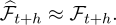
The Seldon formulation instead asks which futures remain reachable under the represented counterfactual family:

This emphasis is close to viability and Hamilton–Jacobi reachability, where the central objects are sets of states that can remain safe, reach targets, or avoid undesirable regions under admissible inputs (Aubin, 1991; Mitchell et al., 2005; Bansal et al., 2017). A point forecast can still be useful, but it is a statistic or selected continuation over the reachable structure rather than the primary object.
Goals are optional represented capabilities.
Definition 11.1 (Acceptable manifold). Where a frame represents goals, viability conditions, risk bounds, or constraints,

is the subset of reachable futures satisfying them.
This overlaps directly with viability kernels and feasible regions in constrained control and model-predictive control (Aubin, 1991; Rawlings et al., 2017; Cunis and Kolmanovsky, 2021). The Seldon terminology is broader because the acceptable subset may be defined over any represented future distinctions, not only a conventional continuous state space.
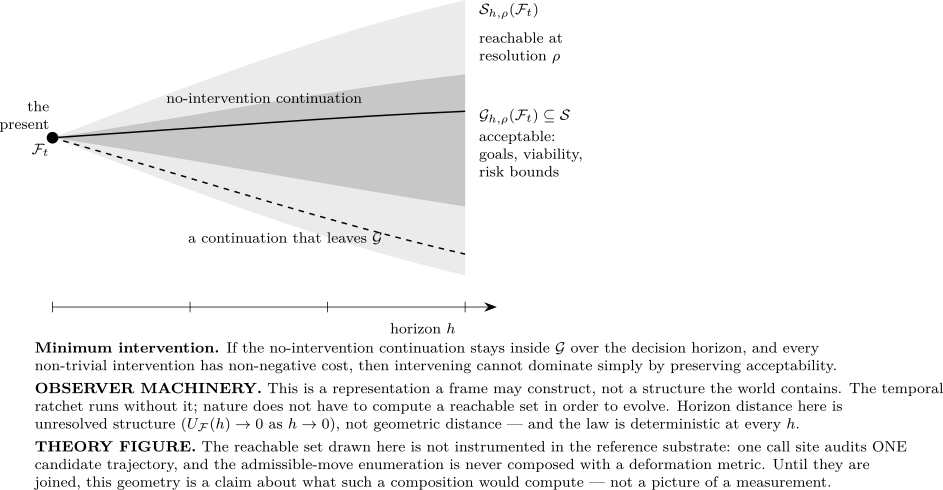
Figure 1 draws the construction.
Proposition 11.2 (Minimum intervention in a safe interior). Suppose the represented no-intervention alternative exists and its continuation remains within the acceptable manifold over the decision horizon. If every non-trivial intervention has non-negative cost and no independent objective rewards intervention itself, then a positive-cost intervention cannot dominate the no-intervention alternative solely by preserving acceptability.
Remark 11.3 (No intervention is an alternative, not NULL). “No intervention” here is an instantiated alternative with a defined consequence, not NULL (Definition 5.1); the proposition does not identify absence with a zero-valued action.
Goal direction. Where local direction is meaningful, let gt be a represented preferred direction through the acceptable region. A grounding may write

for progress. No differentiable structure is required by the substrate; a graph grounding may instead use an ordering or directed edge relation.
The manifold as defined says which continuations are reachable. It does not say they are equally easy, and they are not. A manifold therefore admits scalar fields over it, as many as the frame instantiates, and the geometry of those fields carries as much as the extent does. Which fields a frame holds is a fact about its requirements rather than about the substrate, on the same optional-machinery discipline that governs represented dimensions generally (Remark 1.5). Three are named below because the rest of this account uses them and Narrativium supplies the second of them (its Definition 3.1); the set is illustrative and not closed.
Definition 12.1 (Cost field and contours). Where the frame instantiates the relevant dimension, let CF assign to each continuation in Sh,ρ(Ft) the cost, in that frame’s terms, of reaching it; where it does not, the field is null there rather than large (Definition 5.1). Its sublevel sets {CF ≤ k} are the within-budget regions and their boundaries the contours. A basin is a region closed under cheapest successors — every continuation in it has its cheapest successors in it — and minimal with that property, so that leaving one requires paying above the cheap flow within it.
Remark 12.2 (Relation to prior work on cost landscapes). A scalar field over states summarising the cost of reaching them is standard: read forward it is the label of a shortest-path computation, and its dual read backward, cost-to-go over continuations, is the value function of dynamic programming (Bellman, 1957). Sublevel sets of a Lyapunov function as invariant regions of attraction are textbook (Genesio et al., 1985), and the volume of a basin has since been made a quantitative stability measure (Menck et al., 2013). Descent on a potential with local minima as the characteristic failure is the artificial potential field (Khatib, 1986), and the standard remedy already uses the mathematics named next (Rimon and Koditschek, 1992). A graded field over an agent’s own reachable trajectories is older than either, and the earliest is also the closest: the driver’s field of safe travel is spatial, organism-relative, and bounded by what the driver can still do (Gibson and Crooks, 1938). The developmental-landscape metaphor is a separate lineage with several inequivalent rigorous constructions (Zhou and Li, 2016).
The topology of such a field is likewise solved, with one caveat about which version applies. How sublevel-set topology changes at critical points is the content of Morse theory (Milnor, 1963), whose hypotheses — a smooth function with non-degenerate critical points — this paper’s object does not meet, its values being discrete at operative resolution. The applicable machinery is therefore the discrete form (Forman, 1998), with persistence and the merge tree for basins coalescing under a rising threshold (Edelsbrunner et al., 2002; Carr et al., 2010). This paper relies on that work and adds nothing to it.
Two properties of the cost field matter for what follows. The first is that it has a default direction of travel, and the reason is not that doing nothing is free. It is Graphic Equalisation’s: continuations reusing surviving structure are the cheapest, and that structure carries the frame along rather than holding it at a point, so a frame that does nothing is carried down its cheapest continuation. The descent is where the narrative goes — a pattern Graphic Equalisation holds at the strength the evidence supports rather than a universal of the substrate.
The second is that basins are where the substrate’s persistence phenomena live. A frame inside one returns to it under every cheap continuation and leaves only by paying the ridge; structural lock-in is a basin read from above, and the capacity contour is the contour beyond which the required payment exceeds what the frame has — a different object from the projection horizon h, which bounds depth rather than payment. Whether a basin holds a given frame is therefore a property of the basin against that frame’s capacity, which is why one landscape confines one frame and not another.
A cost field alone is not the whole of it, and taking any fixed set of fields for the whole is the error the construction most invites. Cost is a flow — what reaching a continuation takes — while what may matter equally is the state left behind it: the capacity a frame expects to hold after arriving. That field is not new here. It is the quantity Narrativium defines (its Definition 3.1), and this paper takes it from there rather than defining a second one: write NF for its value over the continuations in Sh,ρ(Ft), subject to the same instantiation condition as CF. The flow/state contrast, the construction of N as a measure over a reachable deformation set (that paper’s Definition 2.1), and its deformation-class typing (its Section 2) all belong to that paper; what is used here is only that the field exists over the same manifold as the cost field.
The two collapse into one field wherever capacity is purely depletive, so that what remains is what was held less what was spent. Narrativium establishes no such law (its Proposition 5.2) and exhibits transitions that net-gain (its Proposition 5.4), so the fields are not in general reducible to one another — though it also names groundings that do supply a conserved accounting, and there the two coincide. What their divergence buys is the representation of two cases a single field cannot carry: an expensive continuation that raises capacity, and a cheap one that lowers it.
Definition 12.3 (Trap). For frame F, a trap is a basin of CF along whose cheap descent NF falls below the cost of the ridge — so that by the time the frame would leave, it can no longer pay to. The direction is the descent’s, not time’s, and the condition is a comparison rather than a monotonicity: capacity merely declining is not enough, and capacity declining from a great height may never reach the threshold. A basin is a place the cheap path returns to; a trap is a basin whose occupancy erodes the means of leaving it. The comparison is between the two fields and cannot be stated within either.
Corollary 12.4 (A trap is where the minimum-intervention antecedent fails). A trap is the case in which Proposition 11.2’s antecedent fails: the capacity field is an objective independent of acceptability, and a frame carrying it may pay to leave a region it is still permitted to occupy. The proposition rules out a positive-cost intervention dominating solely by preserving acceptability; inside a trap the intervention is not bought for acceptability, which is preserved throughout, but for capacity, which is not.
Remark 12.5 (Relation to prior work on capacity fields and traps). A second field measuring what an agent can still do is well occupied. Attainable utility preservation penalises change in an agent’s ability to achieve each of a set of auxiliary objectives (Turner et al., 2020); power is a state functional averaging attainable value over a distribution of objectives, with theorems that, under certain environmental symmetries, average-optimal policies tend to end up in option-preserving states for most reward functions — a claim about destinations, which its authors are explicit does not carry to the actions taken along the way (Turner et al., 2021); relative reachability measures how much of the state space survives an action, relative to a baseline (Krakovna et al., 2018); and empowerment is a task-independent scalar of what an agent can still cause and detect (Klyubin et al., 2005). In economics the pairing is older: a second state variable that current action rewrites, with unstable steady states separating basins, is the structure of rational addiction — whose authors claim priority for exactly that bistability (Becker and Murphy, 1988) — and the specific reason offered above for non-collapse, that expenditure can raise capacity, is the human-capital production function (Ben-Porath, 1967). Combining two separately specified scalar functions at runtime, through a quadratic program that mediates their conflict, is ordinary control practice (Ames et al., 2017).
The trap is likewise named elsewhere, repeatedly, and named as a cross-field object: a habitat cheap by cue on which fitness declines is an ecological trap or attractive sink (Robertson and Hutto, 2006; Delibes et al., 2001), which is precisely a cost field and a capacity field pulling apart; the economic case is the poverty trap (Azariadis and Stachurski, 2005).
What is left after that is narrower than it first looks. It is not that the capacity field is primitive: empowerment is already independent of any auxiliary objective, and Narrativium constructs N from a reachable set (its Definition 3.1). Nor is it that the trap is cross-field: the ecological literature has that, and it is only the potential-field local minimum — where the descent itself stalls — that the cross-field definition distinguishes it from. What survives is that both fields are carried over one frame’s represented reachable set under the instantiation condition, which is the commitment set out below rather than a claim standing beside it.
This paper distinguishes retained distinguishable future possibility (Muchness, Definition 15.1) from the capacity to deform it (N); the contrast is set out in Narrativium (its Section 4). Narrative is unnecessary for defining S, but where a containing frame carries operative history-bearing state, that state may orient the manifold (the momentum paper, Section 2 and its Definition 2.2).
The landscape is also something to change: a frame does not only descend a field, it re-shapes the field others descend. Representing that needs one more thing, because contours show where the narrative goes and say nothing about which parts of the terrain will move.
Definition 12.6 (Deformability). For frame F, the deformability of a region is the cost, in that frame’s terms, of altering the fields over it — of changing what continuations there cost, or what capacity they leave. Write it DF: a field in its own right over the same manifold, under the same instantiation condition, and frame-relative like the others, measuring what this frame can move rather than what is movable.
This is the structure one level up. Changing a landscape is priced, and changing what it costs to change a landscape is priced again; each level is defined whether or not anything can reach it. What finite capacity bounds is not which levels exist but which a frame can act at, so the regress is operationally truncated rather than definitionally terminated — and a frame instantiating no capacity dimension has no economy here to truncate it.
Remark 12.7 (Relation to prior work on pricing structural change). Pricing the alteration of a system rather than action within it is a mature subfield, and the attractive part of it — that a small alteration can produce a large change in where the descent leads — is a theorem there rather than an observation, in a sharper form than is convenient here. Under k-implementation an interested party pays to deform a payoff structure so that a desired outcome becomes the agents’ own cheap path; and because the payments are promises attached to profiles that rational players then do not choose, k can be zero — the deformation is credible and never actually paid for (Monderer and Tennenholtz, 2004). Shortest-path network interdiction fuses this with the cost field directly: cost over a graph of futures, a budgeted adversary altering arc costs, and a bilevel max–min selection of the budgeted alteration that most lengthens the evader’s cheap descent (Israeli and Wood, 2002). Policy teaching modifies an agent’s reward function under an incentive budget (Zhang et al., 2009); performance potentials price a perturbation of a Markov process as a field over states (Cao and Chen, 1997; Cao, 1998); agents seeking states of high future capacity combine that field with the last (Salge et al., 2014), and an organism altering its environment so as to change the selective landscape it subsequently faces is niche construction (Odling-Smee et al., 2003). Outside formal control, resilience theory separates adaptability — which for its authors covers movement between basins and purposeful reshaping of the stability landscape — from transformability, which is the introduction of new state variables and so a different space rather than a different landscape over the same one (Walker et al., 2004); and a formal terrain taxonomy over reachable futures — shelters, glades, lakes, backwaters, trenches — has been built from stability-robust variants of viability kernels and capture basins (Heitzig et al., 2016).
The construction is easiest to hold, and hardest to dodge, in one dimension. A zero-dimensional manifold is a point and carries no reachable structure, so one instantiated dimension is the first case in which any of this says anything; and if the fields can be shown not to collapse there, the objection that a second field is only bookkeeping over a rich state space has nowhere to stand.
Take altitude. The manifold is an interval of altitudes reachable within the horizon, at whatever grain the frame’s instrument and its purposes fix. The cost field is the energy of getting to each of them, and it is asymmetric in the way the construction predicts rather than by stipulation: climbing is paid for, descending is not, because gravity is surviving structure that carries the frame along its cheap continuation. What that direction is is a local fact and not a global one, which matters below: over most air a frame that does nothing descends, and inside a thermal a frame that does nothing climbs. The default is whatever the ambient structure does here.
The capacity field is not that field renamed, and altitude is the cleanest available demonstration of why, because it is stored energy and remaining agency at once and the two come apart at the top. An aircraft’s rate of climb falls with altitude and reaches zero at its ceiling; near it, the airspeed envelope narrows between the stall below and the compressibility limit above, until the range of admissible speeds is a few knots wide. High altitude is therefore a great deal of potential energy and very little capacity to change anything — high on one field and low on the other, on the same scalar, with no second dimension available to explain it away. Three of the four combinations are exhibited here in this one dimension: a powered climb is an expensive continuation that raises capacity, a glider’s still-air descent is a free one that lowers it, and propellant spent to hold altitude is an expensive one that lowers it.
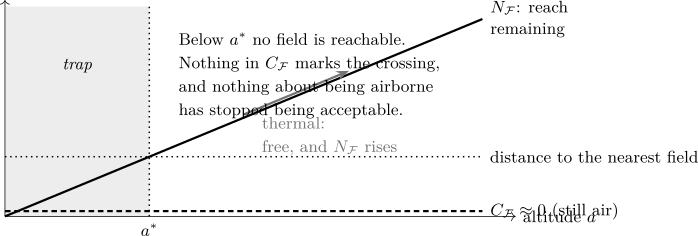
The trap is then the ordinary case rather than a contrived one, and it is where people die. A gliding frame descends for free; its reach is its altitude times its glide ratio, so its capacity to arrive anywhere falls continuously while nothing about the cost field marks the descent as costly and nothing about being airborne stops being acceptable. Past the altitude at which no landing site remains within reach, the frame is still flying, still inside every limit it holds, and can no longer pay to leave. The same shape appears powered: an aircraft whose climb capacity has fallen below the gradient the terrain ahead requires — on a hot day at elevation, where the air is thinner than the altimeter’s reading of it — is in a region it is not leaving, and was in it well before anything observable said so. This is exactly the failure of the inertia principle set out in Section 21, in the smallest setting that can carry it.
It is not even that simple, and the fourth combination is the one that settles the question. A thermal raises a glider’s capacity for no expenditure at all: the frame pays nothing, does nothing, and its reach grows, on the sole condition of being in the right place. If capacity were the cost field kept in another column, a continuation costing nothing would change capacity by nothing. Here one costs nothing and raises it. No depletive reading produces that case, and one dimension is enough to exhibit it.
Two things follow that generalise past gliders. The first is that the gain is a property of where the frame is rather than of what it did, which is what it means for capacity to be a field over the manifold instead of a ledger over the path — Narrativium’s state-versus-flow distinction (its Section 5), met in the smallest case that can meet it. The second is that the capacity field has sources: structure outside the frame’s own economy that does work on it. A closed reading, in which a frame holds what it started with less what it has spent, is not the general case but the special one in which no source is in range. The frame’s economy is not sealed, and nothing in the substrate says it should be.
The thermal is also, in the altitude-only frame, invisible — and that is the grain mechanism of Section 8 arriving unforced. A frame instantiating altitude alone observes its capacity rising with nothing spent, and cannot account for it: something has entered and failed to cohere at the grain held, which is the licence to split. What it splits into is position relative to lift, a dimension it was not previously representing. The thermal does not merely sit in the manifold; it is the pressure that makes the frame grow one.
Soaring is accordingly the closest operational instance of this whole assembly that this account has found, and it is worth conceding as such. Speed-to-fly theory selects an airspeed between thermals by trading altitude against time as a function of the climb rate expected next, which is an optimal policy over a cost field and a capacity field held jointly and neither reduced to the other (MacCready, 1958; Reichmann, 1978); and the final-glide computation every pilot runs — whether reach remaining covers the distance to goal — is Figure 2’s crossing, computed in the cockpit. The construction is not proposing this structure to that field. It is claiming that the structure that field arrived at is general, and naming what it is.
What has been left implicit so far is that the dimension itself has to be indexed to something, and more than one choice is available. Altitude can be held above the terrain or above a fixed datum, and over flat ground the choice is idle — the two differ by a constant, the fields are relabellings of each other, and nothing about the manifold changes. That degenerate case is worth stating because it marks the boundary: an indexing choice that is a pure relabelling is not what this construction means by a frame.
The choice bites when the map between the indexings is not a relabelling, and in the air it usually is not. A glider’s reach in the air mass is the same in every direction; its reach over the ground, in any wind that is not nil, is not, and the difference is not the same set in other coordinates — ground positions reachable downwind are unreachable upwind at the same altitude, so the extent differs, the cost field over it differs, and a basin present in one is absent from the other. Two frames, one glider, one moment, genuinely different manifolds. And the map between them exists and is known: the wind is a map from the air-indexed frame to the ground-indexed one, which is the point rather than an embarrassment to it. Frame-relativity does not entail incomparability. What it denies is a third manifold, indexed to nothing, of which these two are approximations.
Which indexing a frame should hold is settled by where its goal lives, not by which is more real. A landing site is ground-indexed and a thermal is air-indexed, so a glider holds both and converts; speed-to-fly is corrected for wind for exactly this reason (Reichmann, 1978). A frame whose goal is to remain aloft is answered by the air-indexed manifold and misled by the ground-indexed one, and a frame whose goal is to arrive somewhere is answered by the reverse. The sharper failure is not choosing wrongly but mixing: an acceptable region indexed to one frame, compared against a manifold indexed to the other, is a comparison of nothing. Aviation’s recognised version is that the aircraft responds only to the air while the pilot’s perception is anchored to the ground, and the hazard in a turn near the surface is that mismatch rather than the wind itself.
The thermal shows the same doubling at its sharpest. A frame climbing in one gains capacity for nothing in the air-indexed manifold and, in the ground-indexed one, gains capacity and is displaced downwind without having chosen to be. One event, two frames, two different things happening — and no version of it that is happening to nobody.
The limit case settles what kind of difference this is. At a horizontal headwind equal to the feasible forward horizontal component of a steady glide — above stall speed and within the aircraft’s operating envelope — an aircraft has zero groundspeed (Federal Aviation Administration, 2026): it descends straight down over the ground and, in the air mass, does nothing but an ordinary steady glide. Nothing is violated. Airspeed is relative to the surrounding air mass and groundspeed to the earth’s surface; the zero is their wind-indexed vector difference, not a loss of lift. But the two manifolds now disagree about the shape of the trajectory itself — vertical in one, slanted in the other — which is past what a relabelling can produce and past what a skew can produce. A stronger headwind reverses the groundtrack: the descent direction of the cost field, unchanged in the air-indexed frame, runs backwards in the ground-indexed one. The default direction of travel is a local fact about ambient structure, and here is the case where the two frames’ locals point opposite ways.
The same situation is then a trap and a capability at once, and which one it is turns on the goal rather than on any further fact. Indexed to the ground, reach has collapsed to a point: if the goal lies upwind, the frame may fly for hours and arrive nowhere, and no continuation available to it serves — it has continuations in plenty, and none of them are progress. Indexed to the same moment with the goal of landing here, that same collapse is the gift, and the ground roll is nil. Nothing about the aircraft, the air, or the ground differs between the two readings.
A law read off a manifold may therefore be an artefact of the indexing, and this is worth stating precisely because it is not a general licence. That aircraft need runways is a regularity of the ground-indexed manifold under ordinary winds; it is not a law of anything, and the substrate permitted the vertical landing throughout. Other constraints are not like this — the stall is a fact about the air-indexed frame and no choice of indexing removes it. What the case establishes is that the two kinds cannot be told apart from inside a single frame, which is the epistemic content of the commitment made above rather than a metaphysical one.
And the ground-indexed manifold in this case is exactly one-dimensional: altitude is the only thing changing. The simplest case, with which this subsection opened, turns out to be realisable rather than merely pedagogical.
The remaining field is instructive here by being mostly absent. A frame cannot move the terrain, so deformability is null across almost all of an altitude manifold, and where it is not — jettisoning weight, extending a glide, calling for an approach that changes what counts as a landing site — it is precisely the interesting part. That a field can be null over most of its own manifold is the instantiation discipline working, not a defect in it (Definition 5.1).
Two limits keep the example honest. The same dimension supports a grounding in which the fields do collapse: a frame spending propellant to hold altitude is paying flow for state with no conversion available, and there cost and capacity are one field, exactly as the construction allows. And the grain is a frame’s, not the terrain’s — an altimeter reads pressure, an aircraft flies density, and a frame whose instantiated dimension is the first is not thereby wrong about the second so much as not representing it at all.
The fields are prior art, individually and in pairs, and their topology belongs to discrete Morse theory and persistence. What is offered here is an arrangement, one commitment underneath it, and one consequence that follows from carrying two fields at once.
The arrangement is a flow, a state, and a meta: what a continuation costs, what capacity it leaves, and what altering either would cost — carried together over one reachable set, all frame-relative, with a trap defined across fields. It is stated as flow/state/meta rather than as three because the set of fields is not closed, and a fourth would extend the arrangement without disturbing it. The bookkeeping against the nearest neighbours is worth doing explicitly, since it is what decides whether the arrangement survives at all. Empowerment-based work holds capacity and its deformation, but no cost field over a horizon-bounded reachable set (Salge et al., 2014). Interdiction holds cost and its deformation, but no capacity field, and retains an objective model of the graph (Israeli and Wood, 2002). Resilience theory holds all three informally, over a landscape treated as objective (Walker et al., 2004). The viability terrain taxonomy comes closest of any of them, carrying cost-like and capacity-like structure over reachable futures, with the constraint region again a given of the model rather than a frame’s representation (Heitzig et al., 2016). The recurring difference is not the count of fields but the next paragraph.
The commitment is that the fields are frame-relative in the strong sense: they exist only where a frame instantiates them, and there is no observer-free version of which a frame’s version is a coarse reading. This is narrower than, and should not be confused with, the indexical claim that no frame is privileged — which Graphic Equalisation and the physics companion make about quantities that are substrate-level for all that. The change-budget is not among them: a fixed total is a commitment of the physics companion (Section 3) and not of the substrate, and is cited here as that companion’s. The strong sense is what the neighbouring formalisms decline. Belief-space value functions are observer-relative over an objective state space (Kaelbling et al., 1998); the individual’s field of affordances is organism-relative and long established (Warren, 1984; Rietveld and Kiverstein, 2014); the difficulty of an agent being inside what it models is named (Demski and Garrabrant, 2019). But a complete model is retained somewhere in each, and where the extension was seen it was declined in parentheses: a treatment permitting each player “a completely different conception of what game is actually being played, which may have very little relationship to the actual underlying game” adds immediately “although we still assume that the modeler’s game corresponds to the actual game” (Halpern and Rêgo, 2014).
The consequence is a limitation of a result this paper otherwise leans on. Holding a control constant while the acceptable region is respected, and acting only where it would cease to be, is Aubin’s inertia principle, conceded in full in Section 21. A trap is exactly where that discipline fails. Inside one, acceptability is respected throughout, so nothing triggers; meanwhile capacity falls below the cost of the ridge, and by the time the region is finally threatened the intervention the principle would then call for can no longer be paid for. The failure is invisible to a single field, since nothing about the cost landscape has changed — it is statable only because capacity is carried alongside cost. Proposition 11.2 is conditional for the same reason, and Corollary 12.4 states which condition: minimum intervention is minimum sufficient intervention, and a positive-cost intervention can dominate no-intervention when the no-intervention continuation is a trap lying wholly inside G, because there the intervention is bought for capacity and not for acceptability.
What the commitment costs is stated in Section 8, and it costs less than it appears to. A fixed grain does not by itself restore an observer-free object: it makes a finer distinction definable, which is not the same as making a finer fact obtain, and the denial of the latter is available to a fixed-grain frame too. Nor is a generated grain immune to the objection, since it is likewise coarse relative to its own next refinement. What a frame-generated grain buys is not the possibility of the commitment but its self-sufficiency: a frame holding its grain fixed must import from outside itself the standard by which that grain was set. The dependency is therefore one this construction uses, not one it requires.
Definition 15.1 (Muchness). Muchness
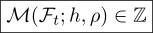
is a frame-relative discrete measure of materially distinguishable future possibility retained within Sh,ρ(Ft).
A grounding supplies a discrete measure

that preserves the distinctions relevant to the claimed domain. It may count distinguishable states, equivalence classes, connected reachable regions, retained capability classes, or use another integer index. Muchness therefore measures how much distinguishable future remains, not how strongly the frame can alter that future.
Proposition 15.2 (Resolution and dimension dependence). Muchness is not meaningful without the frame, represented dimensions, horizon, and resolution that determine which future distinctions exist and which count as distinct.
The term Muchness and its role are specific to this framework. Classical reachable-set and viability theory provide the geometry from which such a measure can be constructed but do not identify this quantity under that name.
Definition 16.1 (Irreversible contraction). An intervention is irreversible relative to frame, horizon, dimensions, and resolution when it makes previously distinguishable valuable future regions unreachable and no admissible continuation within the stated horizon restores them.
Where the Muchness dimension is instantiated before and after the intervention, a simple discrete contraction measure is

Here 0 is a legitimate value on an existing irreversibility dimension, not absence of the dimension (Definition 5.1).
The option value of preserving reversible choices under uncertain future information has a long history in economics (Arrow and Fisher, 1974; Henry, 1974; Dixit and Pindyck, 1994). The present definition is more primitive: it identifies irreversibility structurally with loss of reachable distinctions. No substrate-level probability distribution is required. If a frame overlays probabilities on unresolved future conditions, an expected irreversibility statistic is an epistemic derived quantity, not part of the deterministic Graph Law (Hypothesis 5.1).
Proposition 16.2 (Reversibility preference). If two interventions achieve the same represented objective to equivalent tolerance and otherwise differ only in that one preserves a strict superset of potentially valuable future distinctions, any represented valuation assigning non-negative value to retained optionality weakly prefers the more reversible intervention.
Definition 17.1 (Control). Where intervention is represented, control is deformation of reachable future geometry:

A controller need not predict one exact future trajectory. It may succeed by deforming reachable geometry so that realised collapse remains inside an acceptable region while preserving useful future distinctions. This set-oriented view is close to viability regulation, reachability-based safety control, and constrained model-predictive control (Aubin, 1991; Mitchell et al., 2005; Rawlings et al., 2017; Cunis and Kolmanovsky, 2021).
What several processes share is the substrate graph and its admissibility rules, not a manifold: under the commitment of Section 14 there is no observer-free manifold for them to deform in common. Each process deforms the graph, and a frame individuating that graph holds its own manifold of the result. The composition below is therefore over deformations, read off in one frame’s terms. A local additive approximation
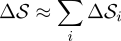
may be useful where interactions are approximately separable. More generally,

Dynamic-game reachability provides established mathematics for reachable sets under interacting or adversarial controls (Mitchell et al., 2005). The Seldon statement is more general and does not require zero-sum or game-theoretic valuation.
This shared-arena case differs from one graph individuated by several frames: each individuating frame carries its own represented dimensions, resolution, and reachable geometry unless a containing relation explicitly couples them.
Why it does not require it is worth stating, since a reader will otherwise supply game theory as the obvious home for this construction. The one-shot game with known payoffs abstracts away the thing this account treats as load-bearing: that the other party persists, that a decision has consequences the deciding frame must then live inside, and that being seen to decide is itself a deformation of what everyone can cheaply do next. Those are not omissions in the mathematics but the conditions under which its idealisation is stated, and the repairs — repeated play, reputation, evolutionary formulations — restore them one at a time, each as a further frame with its own removals. Those repairs are the discipline’s own and are not in dispute here: sufficiently patient players sustain any individually rational payoff in the infinitely repeated game (Fudenberg and Maskin, 1986), tournament and evolutionary play favours reciprocating strategies (Axelrod, 1984), and a small amount of incomplete information about types is enough to generate reputation effects across a long string of encounters (Kreps and Wilson, 1982).
The Seldon construction takes the opposite starting point. Its primitive is a frame’s own reachable future with fields over it, so persistence and consequence are not additions to the model but what the manifold is made of, and there is no configuration of it in which a decision has no aftermath for the frame that made it. That is a difference in what is idealised away rather than a claim that game theory is wrong about what it models — and by the discipline of Graphic Equalisation, both are frames, admissible exactly so far as each says what it removed.
The canonical example makes the point better than the general statement does, and does so at its own expense. In the prisoner’s dilemma defection dominates, both parties defect, and both do worse than if neither had — which is the result the construction is famous for. It holds in the frame as stated. It does not survive the prisoners going back to the prison.
There, the other party persists, is confined nearby, and has associates who were not in the game; what was done becomes known to third parties who never had a payoff in the matrix; and the consequences arrive well after the interrogation the matrix is scoped to. Those are not further terms to be added to the payoffs. They are a change in which futures remain reachable at all, which is what a manifold represents and what a matrix has no place for. Read over the horizon a prisoner actually occupies rather than the one the model is scoped to, the dominant strategy is not dominant, and the cooperation the model calls irrational is the one with the better survival profile.
So the idealisation does not approximate the answer, it inverts it — and the inversion is a horizon artefact rather than a missing variable. Any decision procedure whose horizon ends at the decision will systematically under-weight the costs of defecting, because those costs land past the truncation. That is the same structure as this paper’s treatment of whom a deformation serves, where a continuation reads as serving one party at short range and another at long, and the crossover is a fact about the observer.
The construction is named for prisoners, and the one thing it removes is the prison.
The obvious repair is repetition, and it does not do what it appears to. Iterating a game holds the game fixed and lets the players accumulate history within it, which inverts the invariant the situation actually has. Encounters do not recur; they vary, and rarely with the same stakes, the same options or the same parties. What persists is not the game but the players — and what they carry between encounters is not a record of moves in one matrix but reputation, capacity, relationships, and whatever they have become in the course of it. Repeated play therefore restores persistence by assuming a stage game that stays put, which is the assumption at issue rather than a weakening of it.
Taking that seriously gives a stronger conclusion than the one-shot criticism does. If the games are transient and the players are not, then optimising the game in front of you is optimising the part of the situation that will not survive it, and what carries forward is precisely what the payoff matrix does not score. The defensible form of that is a claim about truncation rather than about strategy: a decision procedure whose horizon ends at the payoff systematically under-weights the consequences that land past it, so accepting the framing is itself a choice with a cost, and the cost is invisible from inside the framing. The failure is at the point of framing and not at the point of choice, which is why it cannot be repaired by choosing better. It is listed as a commitment in Section 22 rather than left as an assertion.
There is a class of exception and it is instructive. Where a sealed frame has been deliberately constructed and is enforced — a sport, an auction, a tender — the game-theoretic reading is correct, because someone has done the work of making the situation actually be a game, bounding what carries in and out. That is what building a game consists of. It also explains the mismatch: the apparatus is right about games, which are artefacts designed to be sealed, and misleading about situations, which are not. Its most famous example is set in a prison.
Two things are claimed here beyond that literature, and only two. The first is the reading of the inversion as a horizon artefact: the folk theorem, reputation and evolutionary formulations each restore a missing consequence by adding structure to the game, whereas the account above locates the defect in where the model’s horizon is cut, so that the same defect recurs in any procedure truncated at the payoff whether or not the game is repeated. The second is the inversion of what persists. Repeated play holds the game fixed and accumulates history within it; the claim here is that the invariant runs the other way — the games are transient and the players persist — so what carries between encounters is reputation, capacity and relationships rather than a record of moves in one matrix, and a manifold over a player’s own reachable futures is the object that carries it. Neither claim contradicts the results cited; both are claims about what the results are results about.
Let {γi} be an explicit family of trajectories.
Hypothesis 19.1 (Reachability compression). For task classes in which many trajectories are equivalent with respect to the operative distinctions at resolution ρ, a representation of their shared reachable geometry can have lower decision-relevant description complexity than explicit trajectory enumeration:

This hypothesis is compatible with the general minimum-description-length principle that useful models exploit shared regularity rather than restating each observation independently (Rissanen, 1978). It is also reflected constructively in set-based reachability methods, which compute or approximate reachable regions without storing every individual trajectory (Mitchell et al., 2005; Maidens et al., 2013). The stronger claim that Seldon representations systematically achieve lower decision-relevant description cost is specific to this paper and remains falsifiable.
The ordinary picture of time,

is misleading as a picture of what determines a continuation, and the correction is structural rather than presentational.
Determination has two components. One is succession: the order realised changes carry through their enabling-relations, which is what makes a time dimension meaningful at all. The other is structural depth: relations instantiated in containing frames, which are present now and are not earlier in time.
Figure 3 contrasts the two pictures directly.
Remark 20.1 (The tilt). Replacing time by structure entirely would be a 90∘ rotation of the causal picture and is not what is claimed. The correct adjustment is closer to a 45∘ change of causal vector: succession still runs, and additional determining structure is reached by depth rather than by reaching further back.
Remark 20.2 (No dependent clocks: a subframe need not be slaved to its container). Because depth and succession are orthogonal, structural containment carries no temporal subordination. A frame’s time is its own change-count (Graphic Equalisation’s Axiom on time, Axiom 1), and with no global clock there is nothing for a contained frame’s clock to be slaved to; each frame counts its own changes. The intuition that a contained process runs within its container’s time is the assumption of a dependent clock, and it is a property of embodiments that happen to share one, not a substrate fact. Consequently a subframe can run faster than its superframe — accumulate more proper time over the same stretch — when more of the fixed change-budget falls in it (a fixed total being the physics companion’s commitment, Section 3, so this reading holds where a container instantiates one and not for frames generally). This does not exceed c: unit c is the same in every frame, being 1 by construction in each frame’s own closure units (the physics companion, Definition 2.1), and what is free is the ratio of change-counts between frames, the distribution of the budget across regions, not the per-change rate. A gravitational subframe’s ratio is bounded by its physics and a computational subframe’s by its throughput; the substrate imposes no dependent-clock law, and the achievable ratio is an engineering fact of the embodiment.
The complement holds equally, and completes the picture: dependence is not forbidden either. A subframe may be driven — ticked by a containing frame, and by one several levels above it — so its clock is then slaved to that superframe’s; this is the coupled, locally synchronous case, and it is a coupling paid for, not a substrate necessity. Clock-coupling between a subframe and a container is therefore a free parameter running from fully independent (asynchronous) to fully ticked (synchronous), and nothing compulsory fixes where a given subframe sits. Reality samples the whole range, which is Graphic Equalisation’s globally-asynchronous, locally-synchronous structure (Remark 11.3) read on the clock: bound and driven subframes are ticked; uncoupled ones run their own change.
Proposition 20.3 (Depth comes from superframes, not from historical frames). Where a continuation is determinable beyond what F0 resolves, the additional determining structure is supplied by containing frames

potentially without a privileged terminal frame. It is not supplied by retained temporal snapshots: by Graphic Equalisation’s history principle (Corollary 12.5), past states influence the present only where they survive as present structure.
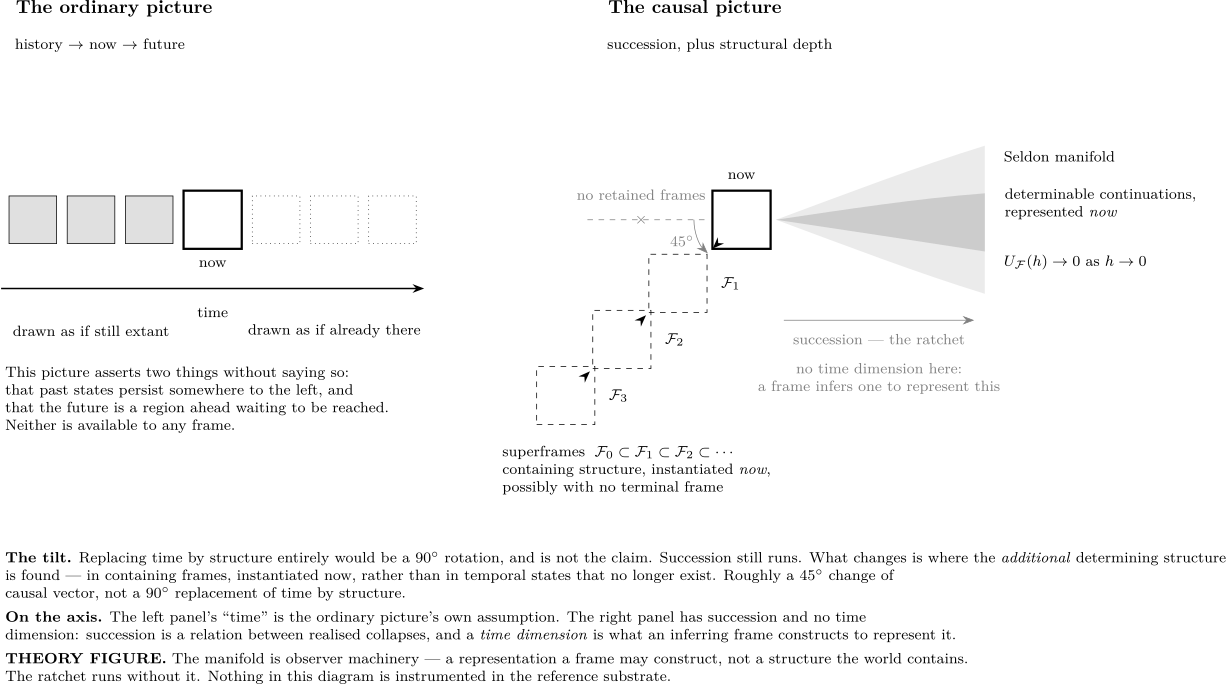
This matters for what an explanation is permitted to assume. A theory that located determining structure in earlier temporal states would require arbitrarily deep access to a past that no frame holds. Locating it in containing frames requires only structure that is instantiated now.
The paper’s relationship to established work can be summarised as follows.
Reachable sets, viability kernels, invariant and capture sets, dynamic programming, model-predictive feasible sets, Hamilton–Jacobi reachability, adaptive numerical resolution, and option value under irreversibility are established (Bellman, 1957; Aubin, 1991; Mitchell et al., 2005; Berger and Oliger, 1984; Arrow and Fisher, 1974; Rawlings et al., 2017).
The Seldon manifold treats these set-valued future structures as a frame-relative representation generated downstream of deterministic Graphic Equalisation and evaluated only on instantiated dimensions at operative discrete resolution.
The terminology and formal roles of the Seldon manifold and Muchness; the explicit separation of local admissibility, counterfactual reachable geometry, deterministic collapse, Muchness, and Narrativium; dimension-instantiation discipline (NULL is not zero); and the decision-relevant reachability-compression hypothesis are claims of this framework.
It is worth being precise about the difference from a reachable set specifically, since that is the nearest established object and the one a reader will substitute if the distinction is not drawn.
A reachable set is an extent, and membership in it is binary: a state is attainable within the horizon or it is not. On the account given here that extent is the support of the structure rather than the structure — the manifold is that support together with the fields of Section 12 over it, and the fields carry what the extent cannot. Three differences follow, in increasing order of how badly the substitution misleads.
The fields are graded where membership is binary, and the grading is not a refinement of the membership question but a replacement for it. Surviving structure prices continuations rather than removing them, so a continuation whose price exceeds anything a frame can pay remains in the set and is excluded by cost, not by admissibility. A reachable set has no way to represent that state of affairs, and a construction that only computed extents would be answering a question this account holds to be the wrong one.
The manifold carries where a frame goes, not only where it could. An extent is indifferent between its members; a cost field has a descent direction, so the construction projects an uninterrupted trajectory rather than merely bounding one. That is a different kind of prediction and is what makes basins, lock-in and the horizon expressible at all.
And the manifold prices its own modification. A reachable set is computed for a system taken as given; deformability is a field over the same manifold recording what altering the generating structure would cost, so the representation includes the terms on which it can itself be changed. This is the point at which the object stops resembling a reachability computation, because the recursion — landscape, cost of re-shaping it, cost of changing that — is internal to the construction rather than external to it, and is bounded by the same finite capacity throughout.
A fourth difference is about use rather than structure. A reachable set answers a question of possibility and carries no preference at all; what is done with it is left entirely outside. A manifold carrying fields supports a decision, and supports more than one: a frame may hold a non-dominated position across its fields, or satisfice on an acceptable region and act only on projected departure, or scalarise into a single objective where it has one. Which discipline applies is the frame’s, not the construction’s, and the paper claims none of them as its own — each is established work, and the acceptable-region form in particular is developed in the viability literature this paper already depends on. What the construction contributes is the object the discipline runs on: the fields, frame-represented and unscalarised unless the frame scalarises them.
It is worth being explicit about how much of this belongs to that literature. Holding a control constant while the region is respected, acting only where it would cease to be, and acting then by the pointwise-minimal admissible change is Aubin’s inertia principle, and the resulting trajectories his heavy viable solutions (Aubin and Frankowska, 1989; Aubin, 1991; Aubin et al., 2011); the engineering form, acting on a projected rather than observed departure, is self-triggered control (Tabuada, 2007; Heemels et al., 2012). That the trigger is projected rather than measured is what makes the forward structure necessary rather than ornamental: a discipline that waits for observed departure needs a boundary test on the current state and nothing more, and would not require a manifold at all. Acting on a projection is what buys the interval in which cheap options still exist, and it is also what exposes the discipline to being wrong in a way a measured trigger is not — the projection may be mistaken, and acting on it spends capacity that a frame with a better manifold would have kept. Nor do the obvious extensions escape it. A constraint region that changes over time, or co-evolves with the system it constrains, is treated there as a viability tube and by mutational analysis (Aubin, 1999); and responding by altering the dynamics rather than steering within them is native to it as well, through viability multipliers and the promotion of fixed coefficients into controls (Aubin et al., 2011). The re-shaping of a landscape, which might have looked like this construction’s own contribution, is not.
One thing the fields do buy against that literature, and it is a limitation of the inertia principle rather than a rival to it. The principle acts when the acceptable region would otherwise cease to be respected; a trap (Definition 12.3) is a region in which acceptability is respected throughout while capacity falls below the cost of leaving, so the trigger never fires, and when it eventually does the response can no longer be afforded. Nothing about the cost landscape changes, so a single field cannot express the failure; it is visible only where capacity is carried alongside cost.
What is left is narrower and is epistemic rather than mathematical. In that literature the constraint region is a given of the model — it may vary, it may co-evolve — but it is not a representation the frame holds and may have wrong. There is no residual between the region as represented and the region as it is, and so no mechanism by which a frame discovers its own constraints were mis-specified and revises them, which is what the substrate’s residual and minting machinery supplies. That is a claim about where the region comes from rather than about what to do once it is given, and it should be weighed knowing that adaptive and learning-based treatments of safe control press on exactly this point.
Stated positively rather than by subtraction, what the construction offers is machinery for seeing the shape of a frame’s potential futures and then working on that shape: not a method for reaching an outcome, but a representation general enough to carry whichever outcomes a frame holds and whichever discipline it applies to them. Its generality is its content. It fixes no fields, since those are what the frame instantiates; it fixes no objective, since acceptability is represented rather than given; and it fixes no rule for acting, since holding a region, ranking by dominance and scalarising are all available to a frame that represents what it needs to. And because the acceptable region is itself represented, what a frame is optimising for is as revisable as how it gets there — which is the same point as the epistemic one above, seen from the other side.
None of which displaces the established work: where the question genuinely is one of extent, the existing machinery answers it and answers it better, and the fields above are defined over exactly the sets that machinery computes. The claim is not that these tools are insufficient for their own question, nor that the decision disciplines above are this paper’s — they are not. It is narrower: that a frame acting on its own future needs fields over the reachable set and not only the set, that which fields those are is its own affair, and that among them may be one pricing the alteration of the rest.
On “a claimed class” and “a claimed grounding”. Several commitments below are indexed to a class or a grounding rather than stated universally, and that is a real weakness unless the index is fixed in advance: a counterexample can otherwise be excluded after the fact by declining to have claimed that class, which makes the commitment untestable by the party holding it. The discipline this paper adopts, stated here so it can be held to it, is that a class counts as claimed once it appears in a grounding section of this corpus, and the claim is then owed for every member of it. Nothing may be added to or removed from a class in response to a result. Where no class has been named the commitment is not yet live, and the honest reading of such an entry is that it states what would be risked rather than what currently is.
On the tags. Each commitment below is marked [shape] or [detail]. A [detail] failing is a revision: the account survives with that mechanism replaced. A [shape] failing costs range rather than a mechanism, because what fails is something the substrate is claimed to require or to permit — so the account does not hold where it claimed to, which is the more serious of the two and is still a boundary rather than an annihilation.
Two entries above are listed rather than banked, and what each risks is narrower than its statement. Basins and persistence is largely entailed by Descent predicts trajectory: a basin is defined as a region closed under cheapest successors, so staying in one is taking cheap continuations and leaving one is not, and what the entry adds is the existence direction, which is all it should be read as risking. Deterministic counterfactual typing is inherited — it is Graphic Equalisation’s graph-law determinism (Proposition 17.1) reaching the Seldon construction, so failing it there fails it here — and the same commitment also appears in the momentum paper (its Section 13): three listings, one risk.
Graphic Equalisation supplies deterministic admissible continuation and collapse. The Seldon manifold is the structured geometry of unrealised counterfactual continuation that remains reachable:

The distinction between reachable geometry and realised history is essential: the manifold contains counterfactual futures because the frame has not fixed all future interventions and containing conditions, not because the Graph Law (Hypothesis 5.1) is stochastic.
The future, in this framework, is not primarily a destination. It is a reachable geometry.
Aaron D. Ames, Xiangru Xu, Jessy W. Grizzle, and Paulo Tabuada. Control barrier function based quadratic programs for safety critical systems. IEEE Transactions on Automatic Control, 62(8):3861–3876, 2017.
Kenneth J. Arrow and Anthony C. Fisher. Environmental preservation, uncertainty, and irreversibility. The Quarterly Journal of Economics, 88(2):312–319, 1974. doi:10.2307/1883074.
Jean-Pierre Aubin and Hélène Frankowska. Dynamic Regulation of Controlled Systems, Inertia Principle and Heavy Viable Solutions. IIASA Working Paper WP-89-086, Laxenburg, 1989.
Jean-Pierre Aubin. A survey of viability theory. SIAM Journal on Control and Optimization, 28(4):749–788, 1990. doi:10.1137/0328044.
Jean-Pierre Aubin. Viability Theory. Birkhäuser, Boston, 1991.
Jean-Pierre Aubin. Mutational and Morphological Analysis: Tools for Shape Evolution and Morphogenesis. Birkhäuser, Boston, 1999.
Jean-Pierre Aubin, Alexandre M. Bayen, and Patrick Saint-Pierre. Viability Theory: New Directions. Springer, Berlin, 2nd edition, 2011.
Robert Axelrod. The Evolution of Cooperation. Basic Books, New York, 1984.
Costas Azariadis and John Stachurski. Poverty traps. In Handbook of Economic Growth, volume 1, pages 295–384. Elsevier, 2005.
Somil Bansal, Mo Chen, Sylvia Herbert, and Claire J. Tomlin. Hamilton–Jacobi reachability: A brief overview and recent advances. In 2017 IEEE 56th Annual Conference on Decision and Control, pages 2242–2253, 2017.
Gary S. Becker and Kevin M. Murphy. A theory of rational addiction. Journal of Political Economy, 96(4):675–700, 1988.
Richard Bellman. Dynamic Programming. Princeton University Press, Princeton, 1957.
Yoram Ben-Porath. The production of human capital and the life cycle of earnings. Journal of Political Economy, 75(4):352–365, 1967.
Marsha J. Berger and Joseph Oliger. Adaptive mesh refinement for hyperbolic partial differential equations. Journal of Computational Physics, 53(3):484–512, 1984. doi:10.1016/0021-9991(84)90073-1.
Xi-Ren Cao and Han-Fu Chen. Perturbation realization, potentials, and sensitivity analysis of Markov processes. IEEE Transactions on Automatic Control, 42(10):1382–1393, 1997.
Xi-Ren Cao. The relations among potentials, perturbation analysis, and Markov decision processes. Discrete Event Dynamic Systems, 8(1):71–87, 1998.
Hamish Carr, Jack Snoeyink, and Michiel van de Panne. Flexible isosurfaces: simplifying and displaying scalar topology using the contour tree. Computational Geometry, 43(1):42–58, 2010.
Torbjørn Cunis and Ilya Kolmanovsky. Viability, viscosity, and storage functions in model-predictive control with terminal constraints. Automatica, 131:109748, 2021.
Miguel Delibes, Pablo Gaona, and Pablo Ferreras. Effects of an attractive sink leading into maladaptive habitat selection. The American Naturalist, 158(3):277–285, 2001.
Abram Demski and Scott Garrabrant. Embedded agency. arXiv:1902.09469, 2019.
Avinash K. Dixit and Robert S. Pindyck. Investment under Uncertainty. Princeton University Press, Princeton, 1994.
Herbert Edelsbrunner, David Letscher, and Afra Zomorodian. Topological persistence and simplification. Discrete & Computational Geometry, 28(4):511–533, 2002.
Federal Aviation Administration. Pilot/Controller Glossary: airspeed and ground speed. FAA Order JO 7110.65, online glossary, accessed 6 September 2026. https://www.faa.gov/air_traffic/publications/atpubs/pcg_html/. Defines airspeed relative to the surrounding air mass and groundspeed relative to the surface of the earth.
Robin Forman. Morse theory for cell complexes. Advances in Mathematics, 134(1):90–145, 1998.
Drew Fudenberg and Eric Maskin. The folk theorem in repeated games with discounting or with incomplete information. Econometrica, 54(3):533–554, 1986. doi:10.2307/1911307.
Roberto Genesio, Michele Tartaglia, and Antonio Vicino. On the estimation of asymptotic stability regions. IEEE Transactions on Automatic Control, 30(8):747–755, 1985.
James J. Gibson and Laurence E. Crooks. A theoretical field-analysis of automobile-driving. American Journal of Psychology, 51(3):453–471, 1938.
Joseph Y. Halpern and Leandro C. Rêgo. Extensive games with possibly unaware players. Mathematical Social Sciences, 70:42–58, 2014.
W. P. M. H. Heemels, K. H. Johansson, and P. Tabuada. An introduction to event-triggered and self-triggered control. In Proceedings of the 51st IEEE Conference on Decision and Control, pages 3270–3285, 2012.
Jobst Heitzig, Tim Kittel, Jonathan F. Donges, and Nora Molkenthin. Topology of sustainable management of dynamical systems with desirable states. Earth System Dynamics, 7(1):21–50, 2016.
Claude Henry. Investment decisions under uncertainty: The “irreversibility effect.” American Economic Review, 64(6):1006–1012, 1974.
Eitan Israeli and R. Kevin Wood. Shortest-path network interdiction. Networks, 40(2):97–111, 2002.
Leslie Pack Kaelbling, Michael L. Littman, and Anthony R. Cassandra. Planning and acting in partially observable stochastic domains. Artificial Intelligence, 101(1–2):99–134, 1998.
Oussama Khatib. Real-time obstacle avoidance for manipulators and mobile robots. International Journal of Robotics Research, 5(1):90–98, 1986.
Alexander S. Klyubin, Daniel Polani, and Chrystopher L. Nehaniv. Empowerment: a universal agent-centric measure of control. In IEEE Congress on Evolutionary Computation, pages 128–135, 2005.
Victoria Krakovna, Laurent Orseau, Ramana Kumar, Miljan Martic, and Shane Legg. Penalizing side effects using stepwise relative reachability. arXiv:1806.01186, 2018.
David M. Kreps and Robert Wilson. Reputation and imperfect information. Journal of Economic Theory, 27(2):253–279, 1982. doi:10.1016/0022-0531(82)90030-8.
John N. Maidens, Shahab Kaynama, Ian M. Mitchell, Meeko M. K. Oishi, and Guy A. Dumont. Lagrangian methods for approximating the viability kernel in high-dimensional systems. Automatica, 49(7):2017–2029, 2013. doi:10.1016/j.automatica.2013.03.020.
Paul B. MacCready, Jr. Optimum airspeed selector. Soaring, 22(2):10–11, 1958.
Peter J. Menck, Jobst Heitzig, Norbert Marwan, and Jürgen Kurths. How basin stability complements the linear-stability paradigm. Nature Physics, 9(2):89–92, 2013.
John Milnor. Morse Theory. Annals of Mathematics Studies 51. Princeton University Press, Princeton, NJ, 1963.
Ian M. Mitchell, Alexandre M. Bayen, and Claire J. Tomlin. A time-dependent Hamilton–Jacobi formulation of reachable sets for continuous dynamic games. IEEE Transactions on Automatic Control, 50(7):947–957, 2005. doi:10.1109/TAC.2005.851439.
Dov Monderer and Moshe Tennenholtz. k-implementation. Journal of Artificial Intelligence Research, 21:37–62, 2004.
Rémi Munos and Andrew Moore. Variable resolution discretization in optimal control. Machine Learning, 49(2–3):291–323, 2002.
National Hurricane Center. Definition of the NHC track forecast cone. National Oceanic and Atmospheric Administration. https://www.nhc.noaa.gov/aboutcone.shtml. Each circle is sized so that two-thirds of historical official forecast errors over a five-year sample fall within it; the 2026 radii are set from the 2021–2025 sample.
F. John Odling-Smee, Kevin N. Laland, and Marcus W. Feldman. Niche Construction: The Neglected Process in Evolution. Princeton University Press, Princeton, NJ, 2003.
James B. Rawlings, David Q. Mayne, and Moritz M. Diehl. Model Predictive Control: Theory, Computation, and Design. Nob Hill Publishing, 2nd edition, 2017.
Helmut Reichmann. Cross-Country Soaring. Soaring Society of America, Los Angeles, 1978. Translation of Streckensegelflug, 1975.
Erik Rietveld and Julian Kiverstein. A rich landscape of affordances. Ecological Psychology, 26(4):325–352, 2014.
Elon Rimon and Daniel E. Koditschek. Exact robot navigation using artificial potential functions. IEEE Transactions on Robotics and Automation, 8(5):501–518, 1992.
Jorma Rissanen. Modeling by shortest data description. Automatica, 14(5):465–471, 1978. doi:10.1016/0005-1098(78)90005-5.
Bruce A. Robertson and Richard L. Hutto. A framework for understanding ecological traps and an evaluation of existing evidence. Ecology, 87(5):1075–1085, 2006.
Christoph Salge, Cornelius Glackin, and Daniel Polani. Changing the environment based on empowerment as intrinsic motivation. Entropy, 16(5):2789–2819, 2014.
Dietmar Szolnoki. Viability kernels and control sets. ESAIM: Control, Optimisation and Calculus of Variations, 5:175–185, 2000.
Paulo Tabuada. Event-triggered real-time scheduling of stabilizing control tasks. IEEE Transactions on Automatic Control, 52(9):1680–1685, 2007.
Alexander Matt Turner, Dylan Hadfield-Menell, and Prasad Tadepalli. Conservative agency via attainable utility preservation. In AAAI/ACM Conference on AI, Ethics, and Society, 2020. arXiv:1902.09725.
Alexander Matt Turner, Logan Smith, Rohin Shah, Andrew Critch, and Prasad Tadepalli. Optimal policies tend to seek power. In Advances in Neural Information Processing Systems, 2021. arXiv:1912.01683.
Brian Walker, C. S. Holling, Stephen R. Carpenter, and Ann Kinzig. Resilience, adaptability and transformability in social–ecological systems. Ecology and Society, 9(2):5, 2004.
William H. Warren. Perceiving affordances: visual guidance of stair climbing. Journal of Experimental Psychology: Human Perception and Performance, 10(5):683–703, 1984.
Haoqi Zhang, David C. Parkes, and Yiling Chen. Policy teaching through reward function learning. In ACM Conference on Electronic Commerce, pages 295–304, 2009.
Peijie Zhou and Tiejun Li. Construction of the landscape for multi-stable systems. Journal of Chemical Physics, 144:094109, 2016.