Software we build.
The lab's engineering runs from a research substrate up to the entity it enables and the simulation it drives. Some of it is open source under permissive and copyleft licences; the research substrate and the entity are not currently released.
Ocelot
Research substrateOcelot is the lab's graph-native cognitive substrate — a typed graph paired with a reflective admissibility grammar, where an agent's reasoning, knowledge, and behaviour are graph data rather than code. It is the engine the papers formalise, and the cognition Bigville can run its residents on.
Ocelot is an active research substrate, not a released product. What is public is the theory — the formal papers — and its application in Bigville. This page describes its general shape.
Jabberwock
Research entityThe Jabberwock is the full realisation of the Ocelot substrate as a first-class digital entity — an agent whose knowledge, reasoning, identity, and history are all one typed graph, running in the engine rather than sitting on top of it. Named for Carroll's poem, it is built to understand raw, novel input by its own machinery rather than by looking answers up.
Like the substrate, it is not an LLM and not trained by gradient descent. It is an active research entity, not a released product; this page describes what it is.
Bigville
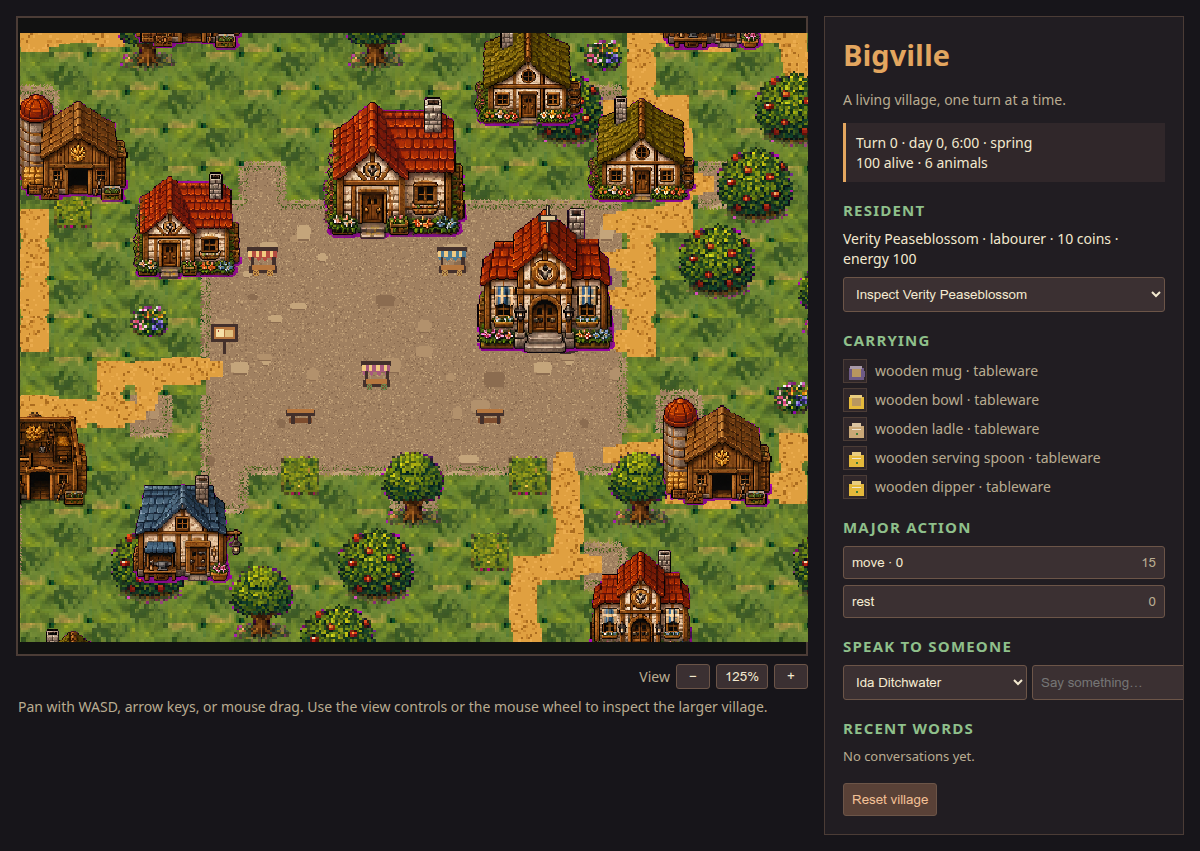
ActiveBigville is a data-driven village simulation and game API. The world holds a map, residents, animals, farms, buildings, food production, trade, storage, law, records, and seeded resident cognition — and actors are driven through a single backend boundary, so a deterministic engine, a human, or a cognition provider can all propose the same validated actions.
It ships with a playable Phaser 3 browser client over the canonical Python world, and a read-only statistical report with a finite-population sample estimate. Bigville runs standalone; it can also drive its residents through the Ocelot substrate.
Ozma
Development pausedOzma is an open-source KVMA router — Keyboard, Video, Mouse, and Audio routed over a network — that grows into a full IT platform: AI agent control, compliance, cameras, backup, and identity, all on your own hardware.
Development is paused indefinitely while the lab focuses on research, and may resume later. The existing code remains open source and available; the product page describes the system as it was designed.